

Castaneda
----
About the Nagual Constitution
----
Zen meditation
----
Working with your story
----
Our mind perception and communication
----
Nlp
----
About memory thoughts and intention
----
About God Jesus and faith
----
About psychotherapy
----
About thoughtpatterns and thoughtstreams

To the Swedish version

Link to info about Daniel Kahneman
Download PDF
New nov 25

This is a quote from the song Anthem by Leonard Cohen. It is probably the most meaningful description of reality one can find.
Creation is not perfect through perfection, but because of this crack that leaves us open to imperfection.
This fact applies to us humans as well as to all creation.
Through this crack, love comes in and goes out, and with this love, with our love, we just have to do the best we can.
Whatever that is.
Bookofmagic is based on more than 50 years of experience in meditation, advanced psychology and deep inner work. Understanding the function
of our brain hemispheres linked to our senses, thoughts, emotions and our body experience during deep meditation can teach us to reach
the place within ourselves where multiple streams of thought exist simultaneously, where our reality is created and where magic is a true reality.
The fundamental purpose of bookofmagic is to help you as a reader to become more free from the often coercive ties and programming that our
upbringing entails. I want to help you become more free to choose your approach and your actions and not least to understand the importance
and significance of your body and your feelings better. To free yourself, you also need an understanding of how our collective values and not
least religion govern us and therefore an understanding of the strong ties that this creates is also required.
At the bottom of all this is our common view of reality and that is where magic comes in. The reality we experience is a fragile creation that
needs to be cared for, BUT in order to become more free, we also need to understand it better and learn to detach ourselves from the often
blind faith and conviction we may have when it comes to what reality is and how it is structured. True magic is the ultimate way to change reality
and when you understand this you also realize how important it is to nurture and protect your life and your values.
The work on bookofmagic is not finished. The book is an ongoing project. I might still make changes and additions. The material has rested for longer and shorter periods. I started writing
this around 1995 and published a shorter English version on the internet about 5 years later. After that, I added material now and then for about 10 years. In 2014, I shut down the website and let the book rest.
In January 2021, I went through the text. I added some things and made some changes and after that I published the English version on the website again.
After various requests from friends and
colleagues, I have translated the book into Swedish and now in spring 2025 bookofmagic is available on the internet in my mother tongue.
The book deals with a difficult subject and may require some effort from the reader. Writing about magic can be provocative for a reader who is very rational and closely bound to scientific requirements.
For those with a scientific education, my text will certainly be very difficult to digest.
The theme is about magic but not at all about magical rituals and the like. Instead, I want to describe how our common image of reality has been created and how it is maintained, and how limited we humans
can be by our upbringing, our education and our cultural and social reality. I do my best to create an understanding that what we call reality is only a very small part of something infinitely larger. When I read
through the text myself, I am a little taken by how much I repeat myself. It may seem somewhat annoying, but the repetitions are a way of emphasizing the importance and significance of the important central
messages that I want to convey.
Most of the text is made up of additions I have made from 2015 onwards. These are mainly about personal development and our psychology, and how we function mentally and emotionally. These are areas
that can be of interest to many people. Much of what I write about our mental functioning and how we think I have not found described elsewhere, nor have I managed to get it confirmed by anyone else with
long experience of deeper inner work. It may therefore be the case that this is at least partly knowledge that has not previously been published.
As it stands, the text can be seen in two ways. It can be seen as a description of what is required to enter the mystery of true magic and perhaps it seems to promise to give instructions on how to find ways to
master magic as in a magic school. However, this is not a textbook on magic. Those who read through the text will realize that I am mostly giving hints and that I am putting a lot of effort into describing how
difficult it is to develop abilities to change perceived reality in more than a very limited extent. For those who really want to deepen their knowledge of the subject, I would like to emphasize that, in my
opinion, it is important to find a teacher. It is probably very difficult to overcome the difficulties you may encounter on your own.
In several of the chapters I address myself here and there with exhortations aimed at those who have the ambition to seriously delve into the subject of magic. I do this because the book is partly written
because I want to highlight the great sacrifices involved in exploring and dissolving the boundaries of what we call reality and how difficult that path can be, as well as how costly the consequences may be.
I want to emphasize that I am not urging anyone to embark on a path that seriously involves magical ambitions. On the contrary, I highlight time and again in the text what this can cost. However, if you test
and use the training methods I describe in the book and "stop halfway", there are great gains to be made in terms of personal maturity, inner harmony and, above all, freedom of choice.
In other words, the book is very much about personal development, albeit at a fairly advanced level. Hence the more important perspective of the text for most readers is that it can be used as a guide in this respect. It is aimed at those who want to find greater maturity and balance in their lives, as well as greater inner peace and happiness. I give a good description of what effective and good psychotherapy can be and the same goes for meditation. Effective psychotherapy with great potential for change, such as Gestalt therapy, which is my field of work, is an activity where a little magic is often part of the work. Good psychotherapy changes the reality of a person's life and experience of life and meditation can do the same. When psychotherapy and meditation are combined, they can often work wonders.
The text on thoughts and thought patterns and how to find ways to work at deeper levels of thought is not easy to say the least. When I write about this, I repeat myself a lot and spend much time on details. That part of the book is probably difficult for many people. For most people, that information and knowledge is probably not something that they want to spend time on. However, the topic can be interesting for providing an understanding of how we function at deeper subconscious levels, and such an understanding can be valuable even if you do not want to delve more specifically into the strategies described. Those who wish to do so may need to spend a lot of time on inner work as preparation before they are even able to start working with patterns of thought in the way described. In order to reach and possibly affect the deeper thought streams that exist within us, you need to have learned to free yourself from and observe your thoughts so that you are as if "beside them." You need to be so free that the thoughts that come are something that just happen alongside you almost as if they are separate from you. For most people, such ability requires many years of meditation and other inner work. I must emphasize that it is very important to see work with subconscious thought streams as something that should only be done as an exercise for short periods of time and that you should balance this type of exercise by letting go and leaving all deeper thoughts alone. In day-to-day life, you should let things be - leave your mind and thoughts alone. The exception to this is that it can sometimes be constructive to keep an eye on ones inner prejudices, findings and judgments and if you have the ability, you can refrain from "locking them" and confirming them so that they control your view of reality.
I might probably work more on the text and make additions and changes. To what extent depends entirely on my other activities. I spend time and energy on my work as a gestalt therapist and on my family, and I also work on other things. For example, I work as a fishing guide in Iceland.

Meditation is the best way to learn to reach deeper than the ordinary and "top" thought stream that most people are aware of. For the most part, the deeper thought processes become faster and the faster
processes often seem to govern the "upper" slower thoughts. Sometimes different thought pathways also operate in parallel. Very deep thought processes are fast in the sense that they seem almost
instantaneous. It is at this deep level that we find what we call intuition. These thought streams are extremely difficult to experience and influence.
I hope that you will find something in my book to add to your personal arsenal of useful knowledge and perhaps what I write will help you to make your life better.
Per-Otto Sylwan
Copyright: Per-Otto Sylwan, Uppsala Sweden. All rights reserved.

I have no ambition whatsoever to convince anyone of the existence of magic. On the contrary, I believe that everyone has every right to their own perception of the world. What I want to do, however, is to pass on insights and knowledge that I myself have found to be relevant to my own worldview and my ability to understand deeper psychological and existential contexts. If you find the first part difficult to cope with, I suggest that you go to the part on meditation and/or psychotherapy by using the links to the right. From there on, the content is more about our mind and body, how we function and how to work with ourselves, our freedom and our well-being. This latter part of the text can be used as a "handbook" for working on deeper personal development.
If you want to explore and learn about our deeper patterns of thought, this part is well worth reading. What I convey in those sections is unusual and perhaps partly new knowledge that I do not think you can find elsewhere.

I ask you to respect my text. You are free to quote and use it as long as you do not claim it as your own. You are required to acknowledge me and my copyright if you quote or republish anything directly.
I am writing this book because I think I know something that I want to share with others. My knowledge comes from over 50 years of meditation and other inner work and from 45 years of work as a Gestalt therapist. Theoretical studies of personal development, meditation and related topics have of course also been important. Apart from the important books by Carlos Castaneda and a few other important sources, I have not focused directly on learning more about the subject of magic during my life, but this is something that has come my way as a "by-product" of other lessons. Although I am not involved in deeper magic at all, at least not on a conscious level, I have to a large extent indirectly gained an insight into the world of magic and perhaps pushed the boundaries of my personal reality a little further than many people.
I devote about twenty pages at the beginning of the book more exclusively to the subject of magic, but as I emphasized in my introduction, this is not a book with detailed instructions on how to perform or work with magic. On the contrary, there are no such instructions in the book at all. I do my best to describe the conditions for magical change and for manipulating our so-called reality. I also do my best to emphasize that true magic is something that requires very deep insights and fundamental changes in the self and in one's entire being. In my text, I place great emphasis on personal development and how to work with your own mind, your own thoughts, and your perceptions and beliefs. In my opinion, it is absolutely necessary to know how reality is dependent on one's own prejudices and programming if one aspires to enter the field of magic and one also needs to get to know one's inner self and the thoughts, ideas and beliefs that govern one's existence.
The book is about the basic assumptions of reality. These are buried deep down in our consciousness in the form of the Creator's/first spirit's intention and purpose, which is the primary reason why there
is a reality at all. Some or most of the training methods I describe in the book are very well suited to personal development in the "normal" sense. Used in this way, they are safe, positive and beneficial for
most people.
On the other hand, some of the training methods, if used in an unthinking and drastic way, can lead to what may be the opposite of personal development and I therefore urge the reader to exercise some
caution. Dealing with real magic means learning to let go of the ties to the reality you are used to and this can lead to alienation and deep confusion. For those of you who want to go deeper and push your
boundaries much further than most people do, I recommend that you put a lot of effort into anchoring yourself in this reality by working on staying and being an ordinary, ordinary person. The best way
to do this is to do ordinary things with ordinary people and to keep a clear boundary between your potential skills and your ordinary life. Don't go around manipulating others or try to influence them in a more
drastic way in your everyday life. If you are sloppy and careless, your actions will backfire on you and you risk being the one who suffers the most from the consequences. I have seen serious consequences
in a few cases of competent and seemingly stable people who dug too deep and were careless.
Making sure you remain ordinary and ordinary is a very important anchor. When it comes to managing one's own life, even the most skillful and wise person has his or her ass behind as we
say in Sweden, i.e. we all need to adapt to the same basic circumstances and conditions of living and existing. This fact is something that no one escapes from regardless of wisdom and inner development
If you want to go directly to chapters in the book, I have listed some topics with links in the menu on the right.

As an example, I present herewith the strongest magic in the modern Christian western world.
Once you understand the meaning of this statement and how much it affects us, you will also have an idea of what magic really is.
In the end, life is just about our beliefs, our faith and our intention and that is all.
As a start, I will also tell you how to perform magic and what you need to achieve in order to perform magic properly.
To perform real magic, you need to be able to be fully in the right hemisphere of your brain and also be in touch with the organizing and structuring power in the left. If you succeed in this, you will be able to
reorganize what you perceive as reality and change it. Maintaining contact with the western half is absolutely essential, otherwise you will lose yourself and have no idea that there is a reality you want to
change.
If you work hard to manage how you use your hemispheres, you will discover that there is a possibility to actually hold your consciousness "in between" your hemispheres. In each case, you experience
it as if there is a place there. When you succeed in doing this, it becomes possible to maintain your connection to structure and order at the same time as you can experience the boderless existence in your
right hemisphere and possibly succeed in manipulating your reality. The place between left and right I describe is discussed in various places in schools for spiritual development. A couple of related
examples are that in China they talk about the energy Chi and in India about Kundalini. Both are considered to be the "spiritual" energy that anatomically resides or is centered in our "middle" in connection
with our spine and wich is in a position outside or beyond the dualistic in existence.
Finding the place I describe is extremely difficult and can take a lifetime (or perhaps more) to learn. You need to experience and learn who you are inside both physically and mentally, and see through the
illusion that the order and orderliness you have learned during your upbringing is a fixed and stable or unchangeable reality. In this book, I attempt to describe, at least in part, some of the steps needed to
loosen the bonds of the programming that shapes our view of reality.
As a start, I would also encourage you to follow this link to YouTube and listen to Jill Bolte Taylor tell her story of how she suddenly lost contact with the left side of her brain: My stroke of insight | Jill Bolte Taylor - YouTube
Her story is very important because it reveals or shows the fact that when you are completely in the right half of your brain, there is no structure and no boundaries in the sense that we normally experience
reality and that when you are there, reality can therefore be changed if you learn how to do this.
Because her story is so important, I will repeat this link several times in the following text
If you wish, you can also visit her website: www.drjilltaylor.com.
Some things to think about
Humanity is on the threshold of a new awareness and a new stage of development. This is now happening quite rapidly and will increase the need for more insight and knowledge about the forces that shape us and underpin our existence. Developments in the IT field risk making us more fixed and enslaved in our reality. It is therefore extremely important to recognize and affirm what is genuinely human and our own deeper feelings.
Magic is neither good nor bad. You can't even say it's a tool because magic is the fundamental truth and force behind reality and our existence. Depending on who you are and your background, there may be forms and rituals that you can experience as magical, but the primary and at deeper levels only tool for real magic is you and your intention. Aids and rituals can be experienced as magical and important, but their function is mainly to help focus your intention in a better way.
When acting on this planet, it is good to remember that you are a child of Mother Earth. Having a sense of where north, south, east and west are can be helpful as this keeps you in line with our planet's magnetic
field and also in touch with the planet itself.
Another thing is that because everything has a rhythm and because the movement of this universe is rhythmic and curved or circular, rhythms and circles can be helpful to some extent.
Your body is your instrument and your own rhythms such as breathing, heart rate and even the pulse in the spinal canal are important tools and can be used as anchors and "reference instruments.
" Muscle tonic rhythm can also be useful in inner work. However, even a good tool or instrument is only useful to a certain extent. In the end, thought, intention and purpose are all there is.
There are no levels of magic because magic just is, but there are levels at which magic can be practiced. There is everyday magic, small magic with small miracles and small everyday changes. There are bigger miracles and big magic that is about bigger changes in society and in human development. At the base and foundation of all this is the true magic that is the magic of thought and intention that can bring about real change and real miracles.
As I said, magic is neither good nor bad, but it can of course be used to do both good and evil. Its potential is unlimited, which is something that everyone who enters the field should consider. Choosing how to use yourself and your abilities is always crucial for all of us, but it can be far more important when practicing real magic than in a more ordinary life.
Although magic has unlimited potential, there are fundamental limitations for an individual practitioner. You cannot change our collective reality just anyway. This is because we all help to maintain our
shared reality. We do this by being active magicians in our deepest subconscious. We operate and promote a shared picture of reality with common frames of reference, which stabilizes and confirms it.
Magical changes on more than a very limited level require very powerful intervention and the larger the area you try to influence, the more you are met and limited by collective counter-forces. It is like walking
into a headwind that turns into a storm and then a hurricane. In order to have an impact at the macro level, you have to influence other people's perception of reality. A Voodoo practitioner's ability to seriously
influence the people around him or her is made possible by the fact that he or she lives in a culture where magic is considered real, and therefore it can be possible to get people in the local community to deeply
believe in and be influenced by various magical changes that are unreasonable to most modern people.
It is important to recognize that different local cultures, such as those of the Amazonian Indian tribes, have or have had a view of life that is fundamentally different from how we in the modern western world view
reality. We simply cannot understand them because their systems of reference, frames of reference and worldview are so fundamentally different from our own.
In our culture, however, we have our own magic where the religions of our time have created a large part of the basis for our perception of reality and on top of this, rational modern science is perhaps the most
decisive force for us.
Remember that nothing is real without compassion, empathy and love, without heart. In the end, what is good and true in life is always stronger and more important than what is evil or bad.
This rule applies to magic and those who practice magic as well as to all other aspects of life. Without love and compassion, life is meaningless and if you lack an open heart, you can never get beyond
a certain point in your own development and maturity as a human being. This is based on an important fact, and that is that without the heart there is a hollow, an emptiness in our being where there
should be a connection between heaven and earth. It is as if the part on which two wings balance has been removed. Without it, it is not even possible to create balance. This emptiness and lack of function of a
closed heart is constitutional and has to do with the basic conditions of creation. Our creator, the first spirit, in his wisdom created universes with this constitutional fact built in, and although reality can be
changed in infinite ways, the basic rules of existence established by the first spirit are immutable.
The reason this "rule" is there is because love is necessary to remind us that we are all parts of the same whole and that we belong together. Any being who uses his or her intent and intention to do evil will
sooner or later fail because he or she does not have an open heart. It is like reaching a big wall that you cannot climb over. The only way to cross the wall is to open your heart. With an open heart, the
connection to the whole will be re-established, making redemption possible and, in time, redemption will also take place.
It is worth emphasizing that the meaning and importance of love and redemption is also the central message of the Christian Gospels, as it is central to other religions and spiritual traditions.
I strongly recommend that readers of this book work above all on developing and nurturing compassion, empathy and love. To do so is to encourage life itself, and to do so is necessary if you want to go
on and claim the right to true conscious existence. Working with the heart precedes all other teaching. The mightiest being without a heart will ultimately fail before the poorest of the poor if in that poverty there
is a living "open heart". It should also be known that the heart can never be killed or defeated, it can only be shaded and hidden away
There is a brotherhood and sisterhood for those who follow the way of the heart. To find and join it, one must look within oneself and find one's own heart.
Basic concepts
Belief
We are all magicians and we all perform magic all the time. For example, there is a little magic in almost everything we say and do and in what we believe to be true or not true. But the stronger magic that we all
do is almost always at a subconscious level, and the most important and potent parts of that activity are buried very deep in our consciousness.
The powerful and real magic that we all perform all the time is to build, maintain and preserve the world around us, the world that we call ?reality?. We begin to do this as soon as we begin to exist in this world.
It is an ongoing process and the more aware we become, the more complex and 'fixed' we tend to make our worldview.
Since we are all performing this magic all the time, one could of course say that we are all magicians. However, being a magician in the true sense of the word and in the way most of us interpret this concept
means having control over the magic you do and thus being able to choose your own reality and sometimes even the reality of others.
Performing magic is a matter of perception and belief. But even if this is true, it tends to miss the point because most people do not have a conscious understanding of the deeper meaning of the word belief. Most of us think of faith as something related only to our superficial intellect and not to ourselves as whole beings, body, mind and spirit and to ourselves as beings where every atom of our body is filled with consciousness and not just our brain.
Our conscious intellect builds its activity on the premises about the world as we perceive it. We see what we perceive as true, real and logical, but we miss the fact that we have all collectively built and defined our reality by operating at a deep, complex and mainly subconscious level. We tend to see the world as something outside of ourselves and we think of its construction as something that someone else has created, or that may just be there without anyone being responsible. To overcome this misconception of the world and what reality is, we need to change our view at and understanding of ourselves and of what it means to believe.
Not believing is as important as believing
This fact is very, very important for the understanding of magic. What we choose not to believe in affects us as much as what we choose to believe in.
If you know and accept this, you eventually realize that everything is a matter of conscious or subconscious choice. If you accept this, you may also come to realize that at a deeper level, everything is possible.
Upholding the world
The magic we perform to keep the dualistic world around us going is hard work. It tires us out and is the main reason for our need for sleep. When we are asleep, we are free to wander around in the dream world
where everything is possible. The dream world is a place of true magic and when we are there, we are constantly creating new realities and/or staying in realities created by others. If we don't sleep,
we hallucinate, we stop being able to perceive the world and the boundaries of reality fade and start to disolve. Consciously entering the world of dreams is one of the basic ways of exercising true magic,
as is consciously leaving this world to go there or, in more advanced cases, by simply going somewhere else and taking your body with you.
Science eats magic
Modern Western science has its own magic. In some ways, there is not much difference between that magic and other magic.
In other ways, there is a gulf that separates it from other magic. The main reason for this gulf is, first, that modern science uses distrust as one of its most central forces and, second, that it needs
machines and equipment for almost everything.
Modern science performs its magic in a very, very formalized, strict and rigid way. Only certain patterns are allowed to work. What lies outside these
patterns is forbidden, ignored or considered not to exist.
Exceptions to this attitude can sometimes be found, for example in modern physics when it breaks new ground. One problem, however, is that even open-minded scientists are often very heavily indoctrinated
with the "truths" that are the cornerstones of science. They often do not realize how untrue or fragile these "truths" can be, and they often do not realize that what they call truths and axioms are almost always
models, built on other models, and that these models, although they can be very advanced and form the basis for scientific development, can sometimes also restrict creativity rather than encourage it. There is
however sometimes a certain wisdom in modern science associated with this fact, and that is that many scientists and also others know that the most groundbreaking discoveries usually come in so-called
basic research, i.e. research wich is more openminded and includes less of preconceived notions and existing models.
There is a big difference between people who "think they know" and those who "know they believe" and many scientists, especially in the natural sciences, are victims of an extremely strong belief that they
know how things are and unfortunately some of them extend this belief far beyond their scientific field and apply it to their personal view of almost everything.
I once saw a TV program where all the Nobel Laureates of the year discussed and presented their views on various topics both in research and various other areas. What was very interesting when following this
discussion was that the Japanese man who had won the literature prize that year gave the impression of being the most sensible, wise and open-minded of them all, and he was just a writer and not a scientist.
Another thing that was a bit pathetic when listening to the discussions between all these very knowledgeable and smart scientists was that they talked quite a lot about how sad it is that ordinary people don't
understand them. No one seemed to realize that it might be their own attitude of knowing better and communicating in an "I know how things are" way that is the main cause of the gap between themselves and
all those they perceive as if they are not understanding them.
The Earth is a shining, wonderful globe full of the magic of creation itself. It shines with the light of magic. In the old pre-Christian world, however, although it can be considered primitive, it was even more luminous. Modern science, combined with the limiting concepts of Christianity and a growing rationality, illuminates the world with its light of scientific and religious truths and with electricity and logical lectures, but science, organized religion and rationality at the same time slowly and effectively extinguish or dim the magical light of a more undestroyed planet. There is an obvious connection between this and the fact that we are slowly and ruthlessly destroying the entire surface of the planet we live on.
While science can bring hope and light, the fact that we are overexploitating our planet sadden both humanity and the planet and the downsides of science and so called progress tend to make people lose hope and feel depressed. However, we should not fall into the trap of thinking that everything was better in the past. Scientific progress is important, but it should not be used as a tool to bring harm, restrict freedom and limit and constrain reality by fixing and locking its boundaries.
Purpose/Intention
There are as many belief systems as there are cultures and people, and they are as important to us as air. I do not primarily mean faith in the religious sense, but mainly faith in terms of the beliefs, values and
attitudes that permeate societies and form the very basis on which they rest. These belief systems are inescapable and necessary because they are the basis of our existence and without them there would be
nothing but chaos.
Each belief system has its own rules and limitations. For most of us, however, our different belief systems overlap, especially at the subconscious level, and the differences are usually very superficial.
Almost all of our basic beliefs as human beings are actually very similar, but the common ground lies largely below the threshold of consciousness. At the conscious level, we sometimes tend to
exaggerate the differences and we may even attack those who have a different view of life. To distinguish the light of others and trying to crusch their belief systems by asserting your own views and demanding
that others live by your rules is not very constructive. While there may be cultural and other habits that are such that it is important to distance oneself from them, for the most part the differences are at such
a level that it is far more interesting and rewarding to be tolerant and accept and enjoy the lifes, experiences and views of others.
Since there are a great number of belief systems there are many ways of practicing magic. There are rituals, rhythms and music, circles and communions of various kinds, such as the Christian
tradition of eating Jesus' body and drinking his blood.
Most people may not realize that the Christian communion is a magical act, and even if they do, they probably don't realize or think about how incredibly extreme and powerful this magic is. For many Christians
it is a reality that the bread and wine are the body and blood of Christ.
If you really think about it, the Christian communion, which is the central ritual of Christianity, has had an incredibly profound impact on humanity and life on our planet over two millennia and its power and
influence as a ritual is enormous.
Rituals are very important at the collective level in groups and communities because they help to focus the beliefs and intentions of many people. However, practicing true magic as an individual does not require
external means or rituals. If you have the skill, all you need is intention.
Intention is central to all magic. When you do magical rituals and use different tools, you use them because you need tools or rituals to open up to deeper levels of consciousness and to focus and sharpen your intention. On a collective level, rituals are however very effective as a way of gaining a common focus.
It is not easy to describe or explain what intention in its deepest sense really is and I hope that your understanding of what it is will grow by reading this book.
Understanding intention in depth is so
intimately connected to the subtle and fundamental aspects of perception and experience that it is more or less impossible to grasp with the intellect. It must be experienced.
Maybe there are other works and books that describe intention and different ways of training oneself to experience intention and intent.
One way to train is meditation and I think it is difficult to find alternatives that are as good or better for training one's ability to focus one's mind so that one's intention is pure, strong and clear. In my opinion,
Zazen or Zen meditation and similar meditation methods without mantras or other distractions are likely to be the most effective.
Since I am writing this book on a serious and important subject, I will try to explain what the essence of intention is when it is completely pure and focused. It is not so easy to describe. The reason
is that I don't think many people realize that we are almost always thinking about several things at once. It's just that we consciously experience only one of these lines of thought. The others lie deeper below
our threshold of consciousness but can sometimes be experienced, especially when internal conflicts arise.
It is not unusual for us to think things that are contradictory at the same time. For example, we may think that we want one thing, but deeper down on another level we may think "no, I can't do that" or "no, I
don't want to". In such a case, we are not clear about what we want to do and we may do it anyway or hesitate or reject it. In addition to this kind of conflict, there may be other thoughts going on in our subconscious
at the same time that add to the unclear situation.
I will write more about our complex thought system later in the book and, as I said, I strongly recommend some form of personal exercise such as meditation for the reader who wants to learn more about how
intention works in our deepest inner self.
In my experience, pure intention is found when your awareness touches the place or part of your mind where thoughts are born. By touching this place with your conscious mind, you can influence what thoughts
will be born. It is a very subtle and meaningful thing and I cannot explain it further or tell you how you can mean to do something with pure focused will and without any distracting thoughts and know how to do it
without having planed how to do it beforehand. You only know it when it is there and
that can be a special thing to experience.
Being aware of your intention at a deep level can be like balancing on a knife edge. You can compare it to being a rally driver, driving a car very fast on a difficult road or a skier going very fast downhill on skis. Some
people are very good at doing this and many others can at least do it, even if they are not very good at it. However, it is quite a different matter if you think about doing this while being fully aware of every decision
that you normally make subconsciously and reflexively due to training. If you have to consciously make every decision regarding every tiny movement of your body and your hands and eyes, it becomes an
impossible thing to drive a car in a rally or to ski fast down a steep slope.
Experiencing intention is like realizing, for a moment of a moment of a moment, that any activity, however small, will change the world forever.
It is like realizing that anything but absolute stillness and absence of thought will do something to you and to everything else around you.
You may also find that it is almost impossible to stay in the place that is free of activity and thought and that the moment you leave it you start doing so many things and are involved in so many
processes that for a brief moment life becomes extremely complicated.
The following story about creation and the first spirit may give you further insight into the topic of intention. It is a simple creation story and it is the true story of the first intention.
It is the story of how everything began and therefore it is also the true story of the source of magic as well as everything else.
The original spirit*
In a beginning there was.................. ? ....................................................
There was not nothing because nothing cannot exist without something.
There was not emptiness because emptiness cannot exist without something.
Let us say that this beginning existed and that it was unimaginable and impossible to grasp or understand.
In this beginning is the original spirit.
In some incomprehensible way, the original spirit is aware of its existence. How it was possible is not possible to grasp or understand.
Yet it is a fact.
Conscious and insightful, in need of something to fill its awareness, the original spirit acted.
First it sent its consciousness as far as it could in one direction, let us call this direction forward.
When it found nothing there, it turned its awareness as far as it could in the opposite direction, which is backward because forward had already been created.
When it didn't find anything there, the original spirit sent its consciousness as far as it could in another direction, which we call left.
When it found nothing there either, it did the same thing in the opposite direction, that is, to the right, because the left had now been created.
Still without result, the original spirit turned its consciousness another 90 degrees and sent it out as far as it could in a direction we can call up.
It still found nothing and with only one direction left to go, it did the same thing downwards.
When the original spirit did not find anything with its consciousness as far as it could go in all six of these directions, it became desperate. It became dizzy and started to spin. It spun faster and faster in all possible directions and suddenly a golden globe appeared, created by the six points of consciousness stretched out in six different directions, now moving so fast and in so many directions that a sphere was created.
And suddenly, as if by a miracle, time and space came into being.
The spirit went to the surface of the sphere and saw that outside was eternity.
It went to the inside and in there was also eternity, even though there suddenly seemed to be a center where there had
previously been some kind of unfathomable nothingness in the place where it had all begun.
The primordial spirit decided to call the sphere the egg of creation and, filled with joy at existence and at having somewhere to be, the primordial spirit expanded and began to fill the universe with creation.
*A part of the inspiration for the above story comes from the books "The flower of life," I and II written by Drunvalo Melchisedec.
About the Big Bang
There is a need to say something about the Big Bang because the above creation story reminds us of this theory. The name Big Bang is new, but the theory or phenomenon is ancient.
It is sometimes called Brahma's Night and Brahma's Day. It is also called the breath of God. The universe contracts when the creator breathes in and expands when he/she breathes out. It is important to realize
that this is an ongoing process and that the Bang as our science calls it is happening right now, BUT not where we are in the process.
The thing is that there is actually only one moment, one now, and that everything exists and happens simultaneously in this now. However, time also exists because movement and distance create time. The fact
that there is both time and no time is one of the things that is very difficult to grasp when it comes to creation and existence. Another difficult thing to grasp is the possibility that there is nothing at all, while at the
same time there is an eternity and endlessness in the universes.
Choices Choices are important. When you choose to open a new path, new possibilities arise. Every choice you make changes your life. However, for most of us, many drastic choices tend to be more or less
neutralized by the tendency of life to make everything return to the normal. Our common view of reality, which we are programmed to and which we have learned and cultivated together, is quite stable and resistant
to impact and change. It is like a contract where we have all agreed on the rules. This contract or common agreement is very difficult to break and there are consequences for those who break it. Our individual
influence on the agreement/contract is very, very limited and reality tends to act like a rubber ball. When you push it, it bounces back and becomes the same round ball it was before.
When you look at what the situation can be like for people who really seriously choose to learn and develop magical abilities, there are differences in how such a choice is made. One thing that can happen is that there are examples of people who seem to have been deprived of their freedom of choice by being mentally hijacked and more or less forced into taking a magic path.
The choice in these circumstances may be to accept what is happening. Without acceptance, a person will never be able to train and learn anything properly. Choosing magic, letting it really happen, opens the way to chaos, to realizing that everything exists in the same place and at the same time, overlapping and merging in all infinity. Time becomes a
true illusion and your intention resting in your mind and heart is your only reliable tool if you want to remain intact. Besides doing your best to keep your heart as a living center, there is one thing that is very
important if you embark on such a path. I have already mentioned it in the previous section, but it bears repeating because it is particularly important. You should work as hard as you can to develop and maintain
your identity as an ordinary, everyday person. This goal should always be there and go hand in hand with training and learning. Being "ordinary" is the best protection you can have against the alienation that
follows the deeper changes required to practice magic. You should avoid anything that makes you seem special and different. Avoid in all ways appearing special or unusual.
You should aim for an ordinary life and ordinary things and actions as far away from the magical world as possible. Magical training There are different ways to go about becoming a magician and training methods can vary. However, there are some basic things that you will need to address in one way or another if you
embark on the path of magic. Some of them are listed below as examples. This list is of course not complete, but what is listed below are important things to think about These are a number of examples. There are more and probably some that I have not thought of.
There are, of course, overlaps between most of the topics in the list. Therefore, each area of training can also be like a gateway and when you start working on one of them, the effect can be generalized to one or
more of the other areas. This also means that it is probably not necessary to train very actively in each of these areas separately, but the broader the training the better as it makes you more complete and more
competent.
Some of the above areas are, in my opinion, absolutely central and these are stilling the mind and opening up to the dream world and orienting oneself in relation to the hemispheres.
In order to deal with these central areas, it is also necessary to examine some of the other areas of training listed. As mentioned, the different areas are interrelated and interdependent. After being banned, suppressed and ignored for a long time, magic is now reappearing or perhaps more correctly, resurrecting in our modern western world.
The importance of the Age of Aquarius should not be underestimated. The change that began in the 1960s started a process that, at least for us Westerners, freed us from a great deal of tradition and from the tight
grip of the Christian Church. The collective consciousness has since developed rapidly and the acceptance of both magic and magical insights has spread. This major change is very clear if you look back 50 to
60 years. In the nineteen seventies, new ideas emerged and old ones were revived on a gradually increasing scope, and they spread with ever-increasing speed. To realize the significance of this change, it must be
remembered that a few hundred years ago, to be accused of practising magic could lead to being burned at the stake, and it was not long ago that one would have been socially isolated if one said and did things
that became fully accepted in the period 1965 to 1985.
The late nineteenth century was absolutely decisive. In terms of magic and its development, schools of magic that had been hidden for hundreds of years suddenly came to light and began to share their knowledge.
There were many new books and ideas during this time. As a second-hand experiencer, it is almost impossible to pass on the knowledge and insights given in Castaneda's books. You need to read them yourself to really understand them.
To give you more insight into the teachings of Don Juan Mathus and the central learning needed for a magician, I will present the following quotes from the book Tales of power by Carlos Castaneda:
Tales of power 1974; pages 231-233, 245, 247-248, 265.) The exact same quotes are also found in the book Patterns of the hypnotic techniques by Milton H Erickson,M.D. volume 1 by
Richard Bandler and John Grinder. The quotes below are addressed to Carlos Castaneda as an apprentice/student. The first act of a teacher is to introduce the idea that the world we think we see is only a picture, a description of the world. Every effort of a teacher is geared towards giving this insight to his or her
pupil. Accepting it seems to be one of the hardest things to do. We are often trapped in our particular worldview, which forces us to know and act as if we know everything about the world. A teacher strives from the
very beginning to stop that perception. Magicians and spiritual teachers call itstopping the inner dialog and they are convinced that it is the single most important technique a student or adept can learn. However, stopping the inner dialog is the key to the world of magic, he says. The rest of the activities are just props. All they do is accelerate the effect of stopping the inner dialog. The teacher changes the view of the world. I have called this view the tonal view. I have said that everything that we are is in that island. The explanation of wizards and magicians says that the
Tonal island is created by our perception, which has been trained to focus on certain elements. Each of these elements and all of them together form our view of the world.
A teacher's task, when it comes to the learner's perception of the world, is to rearrange all the elements into one half of the bubble. By now you must have realized that clearing and reorganizing the Tonal
means rearranging all its elements on the side of our reason and logic. My task has been to bring order to your ordinary view of the world , not to destroy it, but to force it to come together on
the logical rational side. He drew an imaginary circle on the stone and divided it into two along a vertical line. He said that "the art of a teacher was to force his pupil to group his world view on the right half of the circle".
(Author's note: Don Juan sees the body in a slightly different way than we do. He directly connects the left hemisphere of the brain and the right hemisphere of the body in such a way that it is the body that acts
as the bearer of our capacity for order and structure and not the brain) "Walking in that specific way overloads theTonal," he said. "It overwhelms it. You see, the attention of the Tonal has to be directed to its internal creations. It is that attention that creates the
order of the world in the first place, so the Tonal has to be attentive to the elements of its world in order to perceive it, and above all, has to perceive the world as an inner dialogue." "Order in our perception is an exclusive concern of the tonal. Only there can our actions have a sequence. Only there are they like stairs where you can count the steps. There is nothing like that
in Nagual. That is why the view of Tonal is a tool, and as such it is not only the best tool but the only one we have. "Dreaming is a practical tool developed by wizards and magicians," he said. "They were no fools. They knew what they were doing and saw the benefit of Nagual by training their Tonal to
let go for a moment and then grab again. This statement does not make sense to you. But it is what you have been doing all along, training yourself to let go without losing the connection to your fixed reality.
Dreaming, of course, is the crowning achievement of magicians, the ultimate use of Nagual. Castaneda's books and Don Juan's teachings are very important. They also suggest that shamanic and magical traditions have been preserved in secret despite the Christian conquest, oppression,
destruction and extinction of the Indian culture. Certain aspects of Juan Mathus' teachings are particularly important. Of these aspects, the concepts of Tonal, Nagual and the Nagual being are central. Tonal and Nagual As far as Tonal and Nagual are concerned, they are, or at least appear to be, the same as our two bodyhalves and the hemispheres of the brain connected to them. They are
products and manifestations of duality and consequently quite different in quality. They can be compared to yin and yang, male and female aspects of the human self, etc. As can be deduced from the quotes
above, Tonal stands for structure, reason and detachment. Nagual represents feelings, intuition, chaos and unity. To further understand this and to understand the consequences of manipulating
the mechanisms that make up a normal undisturbed use of Tonal and Nagual, one needs to read Castaneda's books or some other work of similar importance if one is able to find one
(which I have not been able to do). I will give an alternative description that is more in line with modern Western concepts Most of us regard the order and sense of order we have achieved during our upbringing as reality. It is like believing that a map is the real landscape and not just a limited description. What we think is
reality is a very small part of something much, much larger and which we can only perceive in a very limited way using our senses and our learning. However, this order is the only thing we have to rely on to
navigate our lives and is therefore of the utmost importance to us.
We are all in contact with the left side of our brain and experience the indescribable, which is reality in the form of perceived experiences and parts that have been systematized and organized. In this
experience, our whole body and all our senses are involved and very important. What we experience in this way emerges in small pieces that we organize and incorporate into our world view.
However, having contact with the right hemisphere is absolutely necessary for us to be able to organize and shape our experiences in the way we need.
Both parts of the brain are therefore equally important and must work together. Because order is so important, we tend to favor the left hemisphere and this leads to an imbalance that can be
debilitating. Due to our upbringing, there can also be disturbances in communication in the brain and the very important communication between the two hemispheres. This happens when someone is
traumatized and/or due to a destructive upbringing forced to arrange things in a way that completely or partially excludes the possibility of communication between the hemispheres.
In such cases there is a tendency to get stuck in the left hemisphere and in a structural loop that "spins around" in such a way that you keep coming back to the same point or conclusion.
If you get stuck mainly in the right hemisphere, which is less common, life will instead become chaotic and disorganized and in the worst cases this leads to psychosis. The Nagual creature It is important to emphasize that the Nagual being in Castaneda's world has a different meaning than the Nagual side of our body. A Nagual being is someone who, because of
his/her constitution, can use his/her Nagual side/half of the brain and its power of change in a way that is not easy for ordinary people.
The Naquala being or individual is interesting. According to don Juan, a Nagual is a very rare and special type of human being. A Nagual is quadripartite while other humans are bipartite.
(Don Juan does not say how but it appears that it is a matter of internal anatomy and seems to affect mainly the nervous system.) By being quadripartite, a Nagual has special characteristics and abilities that
ordinary humans do not have. Among these abilities, the ability to perform magic more easily than others is perhaps the most important. The name Nagual originated in the central parts of the American
continent, but it probably has even older roots. Another old name originating in the Mediterranean region is Lucumon or Lucumone. Each human being consists of two halves of the body separated by a vertical center line in the front-back direction. Our brain is similarly divided into two halves with the very different characteristics
described above. According to what I have deduced, the internal anatomy of the Nagual is such that each of these two halves is perceived internally as if it were split in two. The upshot of this is that there is at least
one more line of separation in his/her being that is not visible to most people, but which those with more open and trained perception can see. It is not physically visible from the outside but can be seen in a person's
aura. The two center lines form a cross that runs through the entire Nagual being from top to bottom. It is probably possible to see this difference inside our brain, or at least it should perhaps be possible with
the help of an MRI machine. The extra division or line of separation makes a big difference in the ability of a Nagual to open up his/her being to both the known and unknown worlds, by using both tonal and nagual,
and to gain ability move more freely between these two aspects of our existence. More about the Nagual creature As mentioned above, the normal human is divided into two halves of the body. These are related and connected to our two hemispheres so that our left half is connected to our right
hemisphere and vice versa. Our being is not only made up of the body we normally see. People with more open eyes may perceive the human being as a luminous oval shape with an egg-like form. This is what is popularly known
as our aura or at least part of it. The division described above is, as far as I can tell, visible in the human aura. This is the traditional sign showing a crosswise connection representing a Lucumon or Nagual. This sign is now closely associated with the Nagual Jesus of Nazareth The result of the Nagual's different constitution seems to among other things be, that his or her inner perception is structured in a somewhat different way than that of ordinary people.
There also seems to be a more complex interaction in the brain in terms of structure and intuition. The possibilities for inner interaction are richer and it is easier for a Nagual than for an ordinary person
to find the place between left and right, which is the place of intention and the place where one can step aside and be less bound by perceived reality. I need to clarify a few things about the books by Carlos Castaneda and my view of the magical school his teacher Juan Mathus represents.
To understand the importance and quality of the right side of our brain, I invite you to follow this link to YouTube and listen to Jill Bolte Taylor tell her
story: My stroke of insight | Jill Bolte Taylor - YouTube If you wish, you can also visit her website: www.drjilltaylor.com. The Nagual Jesus son of Mary and Joseph From the pictures and what I have written in the previous section, it is clear that Jesus was definitely a Nagual. If you believe the accounts of the miracles he performed, it is difficult to draw
any other conclusion. His mother Maria may also have had this uncommon constitution. However, Mary was uneducated, while there are sources that claim that Jesus was educated by skilled teachers in India and
elsewhere. It is likely that Jesus was very adaptable and skilled even as an untrained person. The character Jesus was most likely a Nagual and most likely some other men and women in human history and even today have had or have this characteristic. However, there is no obvious natural connection
between being a Nagual and being a leader or being smart and strong or having spiritual or other wisdom. A Nagual can certainly be as good or bad, wise or unwise, competent or incompetent as any other
human being. Among spiritual leaders, however, I would guess that this characteristic is probably more common than in most other fields of endeavor. This is probably due to the unique characteristic of
the Nagual being that a Nagual has a greater ability than ordinary people to open up to spiritual issues and therefore may be drawn to a spiritually oriented existence. Basques and Etruscans The following theory particularly about the Etruscans is largely speculation based on limited information, mostly in the form of circumstantial evidence. The Nagual creature is, as far as I know, extremely rare. Why it is so is an open question. There must be complicated genetic mechanisms involved. There are a few people who have their internal organs
on the opposite side of the body to most people. It is possible that at some point there may have been a genetic variant of our species that has had parts of its internal anatomy and function altered in a way
that has created the genetic constitution that a Nagual is said to have. If, for example, humans with a different internal anatomy are involved in such a change, it is likely that most cases of some form of internal
duplication did not lead to survival, but perhaps in a few cases it has been successful and may have led to the fourfold division that a Nagual is said to have in its internal anatomy. In the case of the Etruscans, there is evidence to suggest that this group of people, and perhaps the Basques as well, worked actively to breed for the Nagual constitution. This may have affected these two
ethnic groups genetically in other ways as well, so that they have some deviations from the genetics of most humans.
The term Lucumone is an Etruscan word and seems to mean king or leader in a specific way that indicates a particular quality that others lack. This may suggest that the Nagual quality was perhaps
more common in their society than elsewhere. The mystery of the extinction of their culture is now considered mostly to be a result of them being absorbed by their inheritors the Romans. However, no one
really seems to know how this extinction could have happened so quickly almost without leaving traces. More about the Nagual creature As mentioned above, the Nagual quality was probably relatively more common in Etruscan society than elsewhere and perhaps also among the Basques. If the Etruscans bred for this trait, it was perhaps
more widespread in their genetic pool than elsewhere. If so, this may have had consequences when their society suddenly ended.
Nagual individuals may have been more common in this part of Italy long after the Etruscans disappeared. St. Francis of Assisi is one such possible example. He was born in the old Etruscan part of Italy
and there must have been several other such examples in the early Christian world. Leonardo da Vinci may be another example of a Nagual from the same part of Italy.
Whether you believe my theories or not, the Christian Church's pursuit of dissent and other abuses is a great shame. This applies to a great extent to the Catholic Church, which with its Inquisition is
responsible for countless atrocities. However, Protestants and other Christian denominations also bear a heavy responsibility. The hunt for dissenters, ostracization, forced Christianization, etc. is a
large part of the foundation on which ecclesiastical Christianity rests. The systematic extermination of cultures and people on other continents is another part. Public torture, witch burnings, etc. are stains
of shame that are part of our history. The churches today do not lack responsibility because the church has been a main actor in that part of history and because that is what has built up the
churches' current position and their power and influence. For my part, I seriously mean that every priest in a Christian church should begin his service by asking for forgiveness for all the past
injustices that exist in the history on which their activity is based. Just as the extermination of the Jews and the massive persecution and killing of Palestinians should never be forgotten, neither should
these atrocities in our Western history.
Jesus was a very important person. His impact on human history is so enormous that it is almost impossible to imagine. His ideas and teachings deal with issues that are central to us as
human beings. It is a pity that these teachings are linked to the Old Testament of the Bible with all its historical texts, and it is in my opinion important, to decouple the evangelical message from the rest
of the Bible. Instead, we should consider the Old Testament only as a way of placing Jesus in a historical context and as a help to understand what we may need to know
about him as a person. In interpreting the Gospel message, we should start with what is most important. To do this, we should apply and use some steps that are central to all learning.
The first and most important step is learning through imitation/modeling. By following the above steps, we can perhaps determine the following: 1) Jesus seemed to value people equally, whether they were poor or rich, influential or non-influential, male or female. All people have the same value.
One might find other things that are also likely, but hardly as important as these six. Christian churches and congregations often have a strange way of looking at the Gospel message as if it were their property. This may not seem so strange at first glance because this is how people often
act, but when you think about it further, you can see how crazy this attitude is. It is impossible to own someone's actions or the account of someone's actions. No one can own the story of Jesus as told in
the Gospels. Nor can anyone have the right to interpret this message, because the message of the Gospels is a gift to all humanity, Christians and others alike. It is a gift to all who want to be part of and
follow the teachings of Jesus, whether they consider themselves Christians or not. Jesus was a spiritual teacher and he was also a magician. There is no doubt that he could perform the miracles described in the Bible. Such things are possible to do and a Nagual, as described above,
has a natural talent for performing magic. The teachings of Jesus, his example and/or other similar teachings and examples are central if you want to open up to and use your intention and purpose consciously. These same ideas and thoughts
are part of many magical traditions. Carlos Castaneda's teacher Don Juan speaks of the path of the heart and the importance of following that path, and so do many other teachers. Without an open heart
and without compassion, empathy and love, you risk losing yourself. This is important to know for every conscious being, but it is crucial if you choose a path that involves true magic. Jesus' love, his open heart, his renunciation of worldly power and his choice of salvation and foregiveness are the central messages of the Gospels and not least important is the fact that he
used his powers not for his own gain but to help others. As you may understand from what I write, "being a Christian" in my opinion is not primarily being a member of a Christian church but having Jesus as a role model, someone to hold close to your heart
as a help to keep your own heart open. Of course, being part of a church or community can be very good. It can be a way to keep your faith, trust and love alive and to share it with others. A way to feel at
home and rest in something good. I have my own convictions. Human lifestyle, values and prejudices should not be confused with God. God only cares about how we act and that we follow our heart. I must add that although I hold the Christian message in high esteem, this message is not unique and neither is Jesus, even though he is special. God has many messengers and Jesus is just
one of them, even though he has been and still is exceptionally important to us Westerners. To make him unique in the sense that the only right thing to do is to believe in him is to put yourself above all those
who have other beliefs and other prophets. This is NOT a nice thing to do. God is there for all creation and he/she does not make a difference between Christians and people of other faiths. I want to add a few things about how I see God and faith. First of all. We are all God's children and there is a spark of God in all human beings as well as in animals and plants and in everything that exists.
To find God is to find this spark within yourself and to see/recognize it in others and in what surrounds you, what you are a part of. Therefore, in my opinion, faith is not something that you can find by reasoning
logically in your mind or by believing in texts in a book. Faith is not primarily an intellectual thing. It is an experience, something you realize and know with your whole being and with your senses
and feelings strongly involved, not just with your mind. It can be hard to understand how everyone can be special to God, and it can be very hard to accept that people who you think are devilish or evil are as special to God as you are. The experience that is faith is not static, but it evolves and can grow. It needs to do so. It may need to be guarded in order to grow, but once it's there, I don't think you can lose it. There is no return.
This knowledge is always somewhere deep inside us, even if we don't always have it in focus. Just as God needs to be loved, he/she also needs friends more than worshippers. Imagine what it would be like to be cherished and worshipped by everyone else, how enormously lonely it would be.
We all need love and so does God, although this love can be greatly affected by the fact that most of us separate beings also want and need help from God.
I urge you to give God all your love and also to offer your friendship to the best of your ability. I said in the past that you cannot find God in a book. This is only partly true. A book can trigger an experience of faith, as can other things such as something dramatic happening in your life or listening
to someone who makes a strong impression. What I mean is that a book is just a book. The Bible is just a history book and to say that it is the word of God is preposterous. Even the Gospels are just stories
about Jesus. Who wants the God who is so often found in the Old Testament. That image of God is very far from what God is. There is a need to say something more about the fact that Jesus used his extraordinary powers primarily to help others. This is very important. If you have or develop extraordinary talents or abilities, it is
your responsibility to use them primarily for others and not for yourself. This choice is crucial. In fact, the only way to deal with being unusual when it comes to extraordinary abilities is to help others if you do
not want to risk alienating yourself. If you use your abilities mostly for yourself, you are just a manipulative egotist and this leads to isolation. Using your powers for others is in line with the tradition in many
so-called primitive societies. A shaman is supposed to be a servant in his/her community and in turn be provided with food and shelter and whatever he/she needs to live a decent life. There is great wisdom
in this as it helps the shaman to avoid alienation and instead become part of his/her community. There are many different types of meditation. Different methods have their own approach and although many are similar, some may have more specific effects. Some methods are more complete and focus
on your whole being while others may be designed to develop or unlock specific parts of your resources. People with long experience of meditation often know a lot about the illusions of reality and how fragile reality can be. Meditation can allow you to rest in an area close to the boundaries of
reality, and experienced practitioners can achieve a profound openness to the "essence of magic" without having to open up for magical thinking. In this way, they can avoid entering the path of magic
while still learning more about the essence of magic. This is very good and makes meditation an excellent tool for personal development and for gaining deep insights without any drastic
consequences. This is why I strongly recommend meditation as a basic practice for whatever goal you want to achieve. In the following, I give some more information about the Soto School of Zazen.
Still some choices change life drastically because there are still many opportunities available to us inside the ball of reality.
For those who have not consciously intended to embark on the path of magic, the choice is often made by ending up in something that radically changes one's view of the world. It may be an event that radically
affects a person or, perhaps most commonly, an encounter with a special person such as Don Juan Mathus in Castaneda's books. Usually there is a second occasion when one realizes that an important choice
is there and it becomes a more conscious point when a choice takes place.
On the other hand, if you live in a culture where magic is an accepted reality, the choice is usually conscious and you look for a person or a context in which you "apply" to be accepted as a disciple. In both cases,
the choice to enter into such a drastic and transformative learning situation has major consequences. The view of the world and life changes significantly and it is difficult or almost impossible to go back and this
is therefore sometimes called the point of no return. Another metaphor is the opening of Pandora's box
In spiritual teachings, one can find names related to this choice connected with a person entering some form of training, for example the myth of entering the path of the Bodhisattva path.
Develop ordinary skills that are part of a rich and healthy life. Live as much as possible like most people. Do not manipulate life or other people unless it is absolutely necessary and unavoidable. If you succeed
in being ordinary and ordinary, you will stay healthy and probably relatively happy. If not, you may regret the choice you have made. If you notice that you ever let yourself seem special, take a
step back and remember this advice.
You should also realize that special knowledge doesn't make you any different when it comes to dealing with the basic existential dilemma we all share, namely the fact that you exist and have to do your best to
make it meaningful and "worthwhile". In that respect, you will never be more or less special than anyone else.
Magic skills will not make you happier, but using your skills for the good of others and to help the planet is very rewarding and can fill your life with meaning.
The most important thing is to still the mind and the inner dialogue, and this also tends to generalize to all areas of training.
In the case of stilling the mind, this is a process in which bodily awareness is strongly involved. The body and mind are closely linked and it is important to realize that the body is a gateway to the deeper layers
of our mind. Therefore, it is necessary to work with the body and techniques that increase body awareness in order to successfully quiet the mind and gain greater control over one's mind and thought processes.
1968 was certainly an important turning point and the period after that up to around 1985 was like a big melting pot with new ideas emerging and old ones being resurrected and dusted off.
Change was encouraged and everything seemed possible. At first, more profound changes could be noticed mainly in a small, exclusive and often quite young part of the western world's population, but over time,
the seeds that were sown and some of the new things that came to life have spread. The 1990s may seem like a setback to some, but now in the third millennium of our Christian way of counting time, it is
clear that a broad and profound change of attitudes and ideas has gained a strong foothold among large parts of the population. The change at a deeper level is not so clearly visible, but the breadth of changing
attitudes is very clear
Personally, I think Carlos Castaneda's work was among the most important, at least for me. Many of those who were active in the front line of change were deeply affected by these books.
What was special about them was that they described in great detail the process by which a folklorist is introduced to the world of magic.
Castaneda wrote about his experiences as a student of magic in such a way that it is possible to follow his own process very closely, almost as if what he describes is something that happens to yourself.
The learning processes of his Nagual teacher Don Juan Mathus that he was exposed to are so well described that one becomes very deeply involved in Castaneda's own process and therefore gains an
understanding of some of the most important factors connected to opening up to and becoming aware of the magic in the world.
For those who do read them, however, I would like to issue a warning. Do not be fooled into thinking that they are mostly about drugs. In the first few volumes, Castaneda describes several occasions when he
uses mescaline. I know that because of this, some readers have stopped reading after one or more of the first books. However, those who continue to read will realize that drugs are not at all a central part of
Don Juan's teaching. On the contrary, in the later books, Don Juan points out that the use of hallucinogenic drugs can be harmful and destructive and that the only reason Castaneda was allowed to use these
drugs was because he was so stupid and because he could not accept that his view of reality was not the only possible one.
Why the right half? I asked.
That is the side that is tonal, he said. "The teacher always turns to that side, and by on the one hand presenting his pupil in the way of the warrior, he forces him to reason and sobriety and
strength of character and body, and by on the other hand presenting him with unthinkable but real situations which the pupil cannot cope with, he forces him to realize that his reason, though a most wonderful
thing, can only cover a small area.
He said that "the right" way to go was an evasion. The warrior first drew attention to his arms by keeping his fingers folded, and then by looking, without focusing his eyes, at any point directly in front of him on
the path that began at the tip of his foot and ended above the horizon, he literally flooded his Tonal with information. The Tonal, without its one-to-one relationship with the elements of its
description, became unable to speak to itself, and therefore became silent.
(Author's note: This is partly a description of a certain type of walking technique that don Juan taught)
Before the white man, these traditions were a living part of the various native societies of the American continent. A number of these schools and traditions have been hidden and preserved for hundreds of years.
Their emergence from hiding, which is still happening today and which has gradually taken place since the upheaval of the 1970s, is an important part of the spiritual development necessary for the next stage of
human evolution.
We organize the world in the left part of the brain and the more orderly we are, the more we can be forced to stay in or favor that part. The right hemisphere can support us in our ordering mainly through
emotional connections and confirmations, but that side is in its basic function free from order and is instead in contact with what reality really is, i.e. the enormous wholeness from which we have "picked"
defined and ordered a very small part. The fact is that "the real" reality is so free of order that it is indescribable and I cannot tell you what it is. It can only be perceived, and in order to use and navigate it,
it must be at least partially organized.
It should be added that the total difference between our hemispheres that I describe has to do with their basic function. In practice, we have good cooperation between the right and left hemispheres and that
means that their function does not look so totally different. If you for example look at a picture of which functions are located where in the brain, the two halves can look relatively similar. To better understand
this, we can think of each hemisphere as having a "main responsibility" that is consistent with the above picture of total dissimilarity. In our practical day-to-day lives, however, a healthy brain
functions as a whole, with everything working together.
To become a little more free in our lives, it is good to loosen the ties to our order and programming and also from any feelings and bodily reactions involved. If you can step aside and allow time for reflection,
freedom of choice becomes a more tangible reality and you can choose how to act and even, to a large extent, how to react. This is something that can be achieved in good psychotherapy and through
meditation. A combination of both is often very good and helps you to become more balanced and to unblock internal communication.
If you want to go further and increase your freedom of choice, it is important to free yourself to a large extent from the programming in the left hemisphere and also from the sometimes binding and
disturbing perceived emotional communication with the right side. This makes you even more balanced, which can give you the opportunity to rest in or be in the middle or between the two hemispheres.
If you are sufficiently free, you may be able to enter and experience the right hemisphere almost completely without losing contact with the ordering side, and since everything is possible in the
indescribable wholeness of our right, nagual side of the brain, you may be able to reorganize the order in the left part and create change. It's a bit like redrawing a map. Things on the ground suddenly look
different and will be perceived and experienced in a different way.
In the case of the Nagual creature, don Juan does not give us many facts about this particular type of creature except that he or she is four-parted and not just two-parted
In what follows I will add some additional facts to his description.
This is a picture of the traditional Lucumon cross which is also the Nagual cross.
It shows two intersecting lines as well as Nagual's specific diagonal cross layout (see below).
Note the similarity to the Christian cross.
A popular and often used way of describing the two halves of the body is to say that the left side is the female or intuitive part of our being while the right side is the structured or male part. In the Taoist
view, the left half of the body is called the yin part and the right half the yang part. This division is the same for both men and women. A relatively small proportion of the population has the two sides reversed.
The brain is also divided but in the opposite way to the body because the left side of the brain is more directly connected to the right side of the body and vice versa.
The Nagual individual, which in a perceptual and interactive sense is divided into four parts instead of two, functions internally as if there were double intuitive or female parts and double male parts. The four
parts are connected in the brain in a way that creates a diagonal cross in the nagual being. The cross is also visible in the aura, although it is not very obvious. However, the nagual body is not
visually different from the bodies of ordinary people. The result of this unique cross-connection in the brain and spiritual being of the nagual appears to be that the front left part is connected to the back right
part and vice versa and that this connection in the brain goes from the front rightpart to the back left and from the front left part to the back right.
There are various names for this focus of consciousness, such as the place of creation, the place outside dualism and time, the place outside the circle, etc. The important thing is that
this focal point is the place where our pure focused awareness/intention is active and where we can change the perceived worldview if we are sufficiently aware and have the ability, will and
energy to do so. When you rest in this focus, you may be able to explore and use the right part of your brain and still be in control, thereby you can influence reality.
According to Don Juan, people with normal anatomy can also reach this place or focal point and can sometimes act at least as powerfully as any Nagual to bring about change. However, the Nagual seems
to have a lot for free and therefore probably does not need as much training. Sometimes, in rare cases, maybe no specific training may be needed at all.
For me, these books were a turning point that led to new fascinating and exciting insights that changed my life in many ways. They are written in such a way that you, yourself are drawn in and almost feel like
a student. It is easy to be captivated by all this new mystery that you instinctively realize contains genuine knowledge of a kind that is difficult to obtain in any other way. I have also read a few books by a female
disciple of Don Juan Mathus and Castaneda named Florinda Donner. Of these books particularly one, "Being in Dreaming", is similarly very interesting and gives a picture of magic as a realistic force that has a
very deep impact. I highly recommend Castaneda's books and two of Florinda Donner's books make a very convincing contribution that complements what Castaneda writes about.
What can be learned from the books is unique knowledge that I believe is very difficult to find elsewhere. Knowledge that is valuable and can contribute to a deeper understanding of the foundations and
conditions of our existence. It also gives a clear picture of how incredibly different the view of reality and our existence must have been for parts of the population on the American continent in pre-Christian
times, before the white man.
As I have emphasized I see a great deal of value in the knowledge provided in the books. I am however rather or even very critical to parts of the philosophy and the aims and objectives that Don Juan seems
to stand for. He talks a lot about freeing ourselves from the ties that have shaped our lives and that in many ways bind us in a negative way. At the same time, Don Juan sometimes presents himself as a victim
of a tradition that is at least as enslaving and that also gives the impression of leading to loneliness and isolation. There seems to be little interest in anything other than the methods and training to which
Don Juan's tradition and magical school are dedicated. The pupils are partly "caught up" in a strange and exciting world from which it is almost impossible to escape. Interest in the world outside their
own group seems almost non-existent. Young people who do not reach the set goals do receive solid and careful help, but are then left to their fate when, despite the help, they do not reach where they are
striving. It seems to be a selfish and very different world that we get an insight into and it becomes particularly clear in Florinda Donner's book about her apprenticeship which, in relation to Don Juan, is quite
short-lived and ends with Don Juan and the majority of his group leaving both her and Castaneda and a few other adepts to fend for themselves in a world from which they have partly begun to free themselves.
The genetics that govern Nagual quality is unknown to me, but there is every reason to assume that this genetic constitution is very rare. is said in Christianity to mean the Greek initial letters KR, which stand for Kristos or Christ.
This may be true, but just as the usual cross existed and was used as an important symbol long before the time of Jesus, the sign
is an ancient symbol for and graphic description of a Nagual. There are probably those within Christianity who know this but who for some unfathomable reason have chosen to keep it hidden
and secret in the same way that much other important knowledge may have been preserved in secrecy but eradicated in society primarily by the Catholic Church and its Inquisition.
(A fact that many people do not know is that the Inquisition was active until well into the 19th century. Moreover, the Catholic Church probably purged dissenters even after the Inquisition ended.)
Because a Nagual is a very rare individual, there are an enormous number of candidates to choose from among "ordinary people" when looking for someone who can lead and guide others. Contemporary
nagual leaders in more mundane matters are therefore probably extremely rare.
Grinder and Bandler, the two authors and creators of NLP, Neuro Linguistic Programming, claim that the Basques are the only ethnic group they know of where people differ from the way most people function
when it comes to our system for receiving and processing images, words and feelings, what they both called our internal representation system. This difference is quite strange. The
Basques differ in a crucial way from how we humans function in general in terms of functions that are very central to how we function perceptually when we communicate. This deviation could be a
result of them actively trying to breed for the Nagual quality. Their breeding ambitions may have affected the system of perception for the whole population because these functions would very likely work
differently for a person who is a Nagual.
The Etruscans were highly civilized and it is very strange that so little is known and so few traces remain. It may be that powerful and dominant smaller groups, because they had leaders with magical skills,
just went elsewhere when they were threatened. For them, elsewhere may have been an option that meant leaving this reality or this place in our reality. If you read Carlos Castaneda's books, this ability to go
elsewhere, to change reality is one of the rare qualities that a Nagual is said to have and he or she can, as it is said, also take others with them. Therefore, my theory is maybe not completely unthinkable.
Castaneda's and not least Florinda Donner's books contain examples of people suddenly disappearing more or less before their eyes and then suddenly reappearing without any reasonable explanation.
This can be for just a short time or for many days. Castaneda himself was said to have been away from our reality for a long time when his teacher Don Juan suddenly left together with most of his followers.
As far as the Etruscans are concerned, one can imagine that if something similar happened there among the most influential members of the population, it would have a very dramatic effect.
In the late Middle Ages, especially after 1000 and onwards, the Catholic Church ruthlessly hunted down anyone they thought might threaten their power. This was part of a stricter view of what is the right and
true faith that the Catholic Church gradually adopted. Perhaps only people with nagual characteristics who were active in the Church were allowed to exist as long as they were very clear in their support for
the Church.
The Inquisition and the hunt were effective ways of purifying the Church and ridding the world of influences that could compete with the "true faith" of the Christian Church, and gradually have
have also Naguals within the Church likely been hunted and killed along with many other people with ideas and activities that the Catholic Church found uncomfortable. Religiously motivated purges
were and are a very nasty process that, unfortunately, was probably also effective in reducing the part of the gene pool that leads to the birth of Naguals. The Vatican probably knew very well what they were
doing in this regard and they probably did it very deliberately because sometimes Naguals tend to be such that people are drawn to them and to flock to them, especially if they use their powers to help others.
In today's world, Naguals are probably very rare, at least in Europe and in areas where the Catholic Church has had great influence. Those that do exist probably suffer from a lack of knowledge, stamina and
training and/or are wise enough to hide themselves very carefully.
It can be dangerous to be exposed and it may even be that Naguals are still hunted by the Vatican but in secret because their existence can make people realize that Jesus was not as unique as the Church
claims.
Modeling and imitation is how a newborn child learns and modeling continues to be important even as we
grow up.
Learning by listening to verbal messages and instructions starts to play a role as we get older and sometime around 8 to 9 years old this type of learning is used perhaps almost as much as modeling.
However, depending on the situation, this differs and even as adults we sometimes tend to use modeling as a basic way of learning.
This is the case, for example, in most subconscious learning processes.
If we apply this view of learning to the Gospels, we must start with what Jesus did, his actions. These are what really weigh heavily in his teaching and if we compare the four Gospels with
each other and also with other accounts of Jesus, it is possible to discover and understand what is likely to be true and to tease out the central issues.
As a second step, we can begin to look at what he may have taught verbally. Once we begin to study oral teachings more closely, however, we must be wary of misinterpretation and the influence of the
people who convey and report these messages. Thus, one should be quite skeptical when accepting verbal messages, especially after such a long time as the New Testament. In cases where the
4 Gospels convey a similar message, the reliability is of course greater
As a third step, one can study what other people among Jesus' disciples and followers have done and said and how they
seem to interpret Jesus' teachings. In this way, you might find something that confirms what you have found in the first two steps. For my part, I would estimate that in terms of what is the true part of
Jesus' teaching, his actions are about 80%, his verbal message 15% and the rest 5%, but this is of course a very rough estimate.
2) Jesus also seems to have had and shown love empathy and compassion in a very tangible way. He seems to have had a great loving and caring heart.
3) Jesus renounced worldly power.
4) Jesus used his extraordinary powers to help other people.
5) Jesus chose death before compromising his heart.
6) Before he died and in death, he chose and gave forgivness.
More important than his miracles, however, is Jesus' impact on history and this is also magic, perhaps one of the most powerful magics there is even if it does not involve performing great miracles.
In some churches, however, you get a lot of rubbish, messages and commandments that are supposed to be linked to being a true Christian. In addition, sometimes you may be forced or pressured to judge
others outside the church you are a part of or judge someone within the church who violates what is considered right and proper.
I've been around for a while and I've seen Christian churches with crazy commandments and prejudices, such as: Women must not keep their hair down, but must wear a topknot. Women must not use
cosmetics, etc. There are all sorts of commandments, such as that you must not do this or that because if you do, you are a sinner. Every time I have heard this, it has very clearly been due to prejudices
linked to the priests or preachers themselves and/or to other members of the congregations. It is also strange that a church can condemn someone for something such as not wearing their hair in a knot or
for using cosmetics and 10 or 15 years later the same thing may be OK and not a sin at all because the priest or preacher in question has been replaced.
Too often the result of personal prejudices among priests and leading members of a community has been the cause of misery.
I urge you who are reading this to do your best to form your own opinion and to consider what you think is right and what you want to believe. You have all right in the world to interpret the
Gospels in your own way.
When you have this experience, you "just know" without a doubt. There is no need to reason or debate. The heart is at the center of the experience and you just know that you are part of something bigger than
yourself. You may also realize and feel that you have your own loving heart and that it is entirely up to you how you use your power to love.
This free will is God's greatest gift.
Another thing is that when you experience faith, it is also more OK to be separate, to be a small part of the richness that is God's creation.
You do not have to do things to please God. You are special to him/her anyway. There are no conditions.
Accepting that we are separate is an important thing. We may long for unity, for not being alone, but being separate is as important as being in unity.
The tendency to think that unity, being one with God, is the right thing is very strong from our separate position, but that does not mean that separateness is wrong. From the perspective of unity, separateness
is more desirable than unity. God wants it both ways. He/she is in many ways incomprehensible and full of contradictions if you try to understand it logically. You can only understand God when your heart and emotions
are involved and then you might also understand the importance of love and how it can be that God loves all of creation and everyone equally.
In my opinion, there is one very important thing to understand about God. God does not need your worship in the first place, but your love. I urge you to think about this. Take a look inside yourself.
Deep within your own heart and your own being you will find your own need for total unconditional love. It is in this that we are the image of God and not in our outer being.
Believing in texts can be dangerous because the texts are too inflexible and too full of human prejudices. On top of this come the interpretations that churches or preachers leave us.
Interpretations that are often clouded by the prejudices of the interpreter. This is why it is so important to form your own opinion when it comes to messages in books or oral sermons.
If you follow the words of a book instead of your own heart, you may end up making choices that you will deeply regret, and if you follow a preacher's advice even though you know it is not right, you may end
up suffering and worrying.
I remember a program on Swedish television where a woman with a hidden camera went to several Muslim priests to ask if she could say no to her husband when he wanted to have sex or if she had to do
it even though she didn't want to or didn't feel well. Almost all of the mullahs she asked said that she had no right to say no. In fact, they seemed to think that rape within marriage is ok.
This is very frightening and says something about how confused priests can be. In this example, it is Muslim priests who are acting in a very bad way. Something similar can of course also happen, and
unfortunately sometimes does, with Christian priests and other spiritual leaders.
In our complex society, you cannot be a shaman or a helper in the way that it works in a small tribe. In our society, people with unusual abilities usually have to hide to avoid being exploited. If, on the other
hand, you have more limited powers, you are usually free to act as a helper and use your abilities in an accepted niche. If you do that, I think you should embrace the shaman tradition and not charge more
than you feel is right. If you start to see profit as too important, there are risks for yourself. It is also true that sometimes, when needed, you should help people for free or at a reduced price, BUT it must also be
said that this is not a rule to be followed at all costs. If you give and give without concidering your own needs, you can exhaust yourself completely and then you will be of no use to anyone and least of all
to yourself. Thus, even if you are a helper, you have the right to put yourself first as long as it is not at the expense of others. Your first concern should be yourself, which means taking care of yourself
and prioritizing yourself in a way that keeps you healthy and happy. If you allow others to empty you, you will end up not being able to help anyone. You need to sometimes be able to say no.

As I mentioned in the previous, I think Zen meditation/Zazen is a good method to use. I recommend the Soto school tradition because it is very pure and simple. Other Zen schools and other methods
such as Vipasana, TM or Acem and different versions of what is called Mindfullness are also very good and have similar effects, but using a mantra as in TM and Acem can be an obstacle and be in
the way when you reach the deeper parts of your inner self.
Regardless of the method, meditation is usually a good way to be with yourself, to get closer to yourself and to become more relaxed, and meditating is therefore good for you no matter what your goals are.
The key is to find a method that feels good to work with and that suits your own personality and your needs. The more complete meditation methods, such as Zazen, work to strengthen the here and now
consciousness, reduce and loosen the ties to the inner dialogue and help to free the practitioner in those areas where the self or mind is negatively tied to the personal history.
Meditation also helps to gradually reduce mental and physical tension.
One very good thing about meditation is that in most traditions and schools it is a method that is effective and at the same time kind to the practitioner.
What may seem a little strange in this context is also that meditation is in some ways counter-effective in relation to magic. The reason for this is that all good and healthy methods of meditation have their
own built-in positive process. They gradually reduce and calm the inner dialog, open the heart chakra and make us more relaxed, focused and content.
The opening of the heart chakra brings mental and physical balance and makes us less restless or overly ambitious.
Zen meditation

Zen meditation has developed as part of Japanese Zen Buddhism. It is a very effective tool for deep relaxation and for achieving inner peace.
Zen brings us into better contact with ourselves physically and mentally and also with the subconscious parts of our being. It helps us to link our here-and-now consciousness to our inner world.
Because Zen thus helps us to connect to our "inner garden", this will, over time, reduce the stress in our system for internal preparedness and our level of tension will gradually decrease. When we make
better contact with our inner self, we also automatically improve our contact with the outside world. This increases vitality and joy in life and makes us more creative.
Regular practice of Zen meditation opens the heart chakra, strengthens our conscious self and improves balance physically and mentally. It also helps us to integrate parts of our self that block our
perception and vitality.
The central and most important thing is that meditation awakens and strengthens the part of our being that can allow us to step aside in our mind and look at or observe
our feelings, thoughts and fears as if from the outside. Gradually, we can gain more control and stop being victims of thoughts, feelings and experiences. This gives us a safer platform in life.
Zen meditation in the Soto school focuses on the central parts of our mind and body. It is a very pure method that can be easily practiced without mysticism and religious trappings.
In the Soto tradition, the meditation is called "ZaZen", which means approximately sitting.
There are no additional techniques such as choans and/or similar thought exercises. Doing ZaZen involves only sitting and being with yourself.
As our instrument for perception, thoughts and feelings, the body is important as the focus of our mind. Breathing, which is the most obvious rhythm in our body is central as another focal point.
The breath becomes a kind of anchor and link between our conscious and subconscious minds.
The method is very simple and it does not matter whether the practitioner has spiritual or psychological ambitions or just wants to become more relaxed. Doing ZaZen works the same way for everyone regardless of their goals.
A more relaxed attitude to life, better health and increased well-being are some of the most common rewards for most people.
It should be said that what I am describing is common to a number of different meditation methods. I myself have practiced Zazen for over 50 years, but I have tried and used several other methods, including TM, Mindfullness and Vipasana, and I have also tested a very large number of different relaxation methods, yoga, hypnosis, etc. as well as methods for various types of body-oriented treatment. Almost everything I have tried in this way, I have experienced as positive contributions in my own development. Training to focus on one's own body, its inner rhythms and breathing is one of the most important things you can do to become more harmonious and find good mental balance.
The method
Zen meditation is traditionally practiced sitting in the lotus, half-lotus or diamond position. The lotus position is valuable for several reasons. It is highly functional both physiologically and anatomically, which is valuable if you exercise regularly. Beyond this, the lotus position is
important on a symbolic level. It is a very strong archetype that is widely distributed throughout the world and is no less important than, for example, the Christian cross,
the Buddha figure or the Taoist yinyang symbol.
Usually, you sit on a small cushion or low chair. However, it is possible and perfectly ok to sit in a regular chair or in a sofa. It is much more important to feel comfortable than to do things in a
strict or orthodox way.

The lotus position should not be overemphasized. The central method of ZaZen is how you focus your mind, and that practice will do its work and produce results whatever the position. Meditation can therefore actually be done lying down as long as you take into account the complication that this also triggers our sleep mechanisms. Falling asleep interrupts the meditation process and is not recommended as a habit, BUT it can happen even in a sitting position and if you are very tired or perhaps ill, it is probably better to sleep than to meditate so you should not make a big deal of the need to stay awake. Being comfortable is much more important and there are still benefits to meditating even if you fall asleep
If you want to practice ZaZen traditionally, sitting in an upright position, it involves resting your weight on your sitting bones on either side of your sacrum, which causes your spine/body to balance vertically.

According to many teachers, one trick to sitting in a good way is to imagine being held up by a thread from the sacrum up through the spine and back of the skull.
The hands are traditionally held in with the back of one hand resting in the palm of the other hand and with the tips of the thumbs meeting above. Other ways of positioning the hands can be used. Feeling comfortable is always important.

ZaZen is traditionally performed with the eyes open and with the gaze resting about 1.5 to 2 meters in front of the body. Defocusing the eyes and letting them rest is recommended. It is not wrong to close your eyes if you feel better that way. Try both ways and do what feels best for you. Keeping your eyes open can be a way to link your inner life with external reality, so it may be a good idea to try it occasionally, even if you usually prefer to keep your eyes closed.
Step-by-step instruction
In transcendental meditation such as TM or ACEM, the process is similar, but you have a mantra instead of using your body and breath as the focus. A mantra is a rhythmic sound or word that you repeat mentally and use as the focus of your mind.
Remember that there is absolutely nothing wrong with thinking about something else or getting lost in any thoughts. It's how we humans work and it's completely natural. The same thing happens
when you are about to fall asleep. You drift off into different types of thoughts and/or memories.
In most effective meditation methods, some form of focusing your mind is central as a way of strengthening your present-moment awareness. But it is important that this focusing is very subtle. Effort will
only counteract the effect and increase tension rather than reduce it. Eventually, this subtle focusing activity will make the thoughts from your subconscious less strong and dominant and this helps to increase
your mental freedom.
Over time, this will also give you the opportunity to experience what it is like to be without any thoughts at all. Know, however, that there are always thoughts in your mind, but the ones that are deepest and
partly shape your conscious self are usually or seem to be invisible and out of reach. They are also extremely fast and almost impossible to reach. Awareness of these thoughts may come gradually as a
result of the usual process of meditation in which you focus easily on your body and breathing as soon as you realize that your mind has wandered away.
As the meditation process gradually develops, awareness of the body may also include other bodily rhythms besides breathing, and among these the heart rhythm is central. There may or will come a point
when you discover that the heart rhythm is 'just there', BUT you should not look for it at the expense of your breathing. Let it just appear and be added to your awareness of the body and breath.
Certain types of illnesses, such as acute infections, can make it harder to meditate in the way you are used to. Be kind to yourself and take it easy. For example, closing your eyes and/or sitting differently and more comfortably than usual can be very helpful if you are suffering from an acute infection or other tiring illness. If you are very ill, it can be very good to lie down and meditate.
I recommend that you start meditating with the help of an experienced teacher, but it is of course possible to start on your own. The instructions above provide good help for those who want to do so. However, starting with a teacher can in many cases be a good way to approach the meditation process. Having a teacher also often means learning in a group, which can be beneficial. A teacher can also help to avoid mistakes at the beginning of the process. However, it is important not to overemphasize the need to have a teacher present and if you feel comfortable starting on your own, I recommend you do so.
As mentioned above, it is not necessary to sit in the lotus position, even if it is a good position. It is more important to feel comfortable and feel good. If you are sitting in a chair, just like in lotus or diamond pose, it is very good to try to find a position where you rest on your sitting bones and have your spine in a natural straight position. You can choose to sit with the soles of your feet on the floor
or with your feet pulled back and under your body/chair.
When it comes to the hands, it is good to hold the backside of one hand resting in the palm of the other hand as described above. This way of holding the hands connects the energy between the two sides of the body. However, it is perfectly fine to just rest your hands in your lap or find another way to hold them. There are ways of holding your hands that include touching key acupuncture points and if you know of any such variations that are comfortable, try them. Touching key acupuncture points on your hands can be very helpful if you are not feeling completely well. One such position that works well and is positive and healthy is, for example, holding the thumb of one hand with a light touch in the center of the cupped palm of the other hand.

can be a good alternative if you want to sit on the floor but do not find the lotus position sufficiently comfortable.
If you choose not to sit with your back upright in a natural straight position, you should try to find symmetry and some form of bodily balance in some other way. For example, it can be very helpful to use pillows as a support if you want to lean back in a sofa or chair.

History constitutes the building blocks of your existence. Your personal history as well as the history you share with other people and with humanity are equally important parts but indifferent ways. History affects you so deeply that it influence almost everything you do. It is the basis for your learning and programming. History connects you with your reality and it mostly does so without you realizing it or think about it. If you should think about it, you would usually choose to leave it alone because it feels safe, maybe even good, and you usually have no reason or ability to change the way things are.
To become freer, one needs to detach oneself from ones personal historical ties. It can be wise to be careful and cautious, as well as to give oneself time when working on this.
Some form of anchor may be needed to stay balanced and stable if and when one comes into contact with complicated building blocks in ones life, for example in the form of traumas.
The choice of method can be significant in that regard. Meditation, as mentioned above, is a good way to free yourself in a friendly and considerate way. The same goes for
psychotherapy and there are also many different methods for personal development on the market as well as books to read.
Working with the ties to our shared history is more complicated and often requires more drastic methods, although meditation has its effect even in that case. There is also a
connection between the personal and the collective and the more one frees oneself from personal ties, the more the perception of reality usually changes, and as a consequence
so do the ties to our collective reality.
There are many similarities and overlaps between the processes of working with history and working with time references. Both processes aim to free the mind from the structures and sometimes preconceived notions that bind us. Of course, all history is a product of time, because history is about the past and to realize how much of an illusion time is, we may also need to think of history as an illusion. It is important to point out that working with history does not mean erasing it. What is needed is to change your view and become more free. The history that you are used to and want to be in is important and can also be used as an anchor and a reference point
.
Remember your history
Remembering your historyis a way of loosening the ties that bind you and allowing you to look at yourself and the world with fewer conscious and unconscious preconceptions. This can be done in different ways, although most methods are quite similar in their approach. One way is to write down your personal history in as much detail as possible. If you wish, you can supplement this written document with paintings and drawings. Another good way is to create a picture of your "life path" where, by marking important periods and events, you also design your path in a way that illustrates memories and experiences, e.g. with figures and colors to show how you experienced different life periods and events. You can also make maps of how you relate to people, places, things, values and ideas. Both in the written parts and in drawings and maps, it is important to note the feelings associated with people, things, places and experiences. It is very good to share your memories with someone and at the same time perhaps get help to process any problematic and/or traumatic parts.
Remembering and even sometimes reliving is the most important thing and if you take the time and do it properly and thoroughly, it can be of great value.
Psychotherapy is an important method for reliving and to "discharge" memories and traumas. Having a therapist to share memories with can be very important. More systematic work with memories takes place in psychoanalysis, but some newer methods also have a more systematic approach. More body-oriented therapies often have great potential when it comes to reliving and processing trauma.
Unraveling a trauma requires that old feelings play a central role in the processing and bodily focus facilitates such work
. A more drastic method to work with our history is described in Carlos Castaneda's work. It goes like this: You start by building a box where you can sit comfortably. It is an advantage if the box is well
insulated so that you are not disturbed by sounds from outside. There should be no light in the box.
To work on your story, sit in the box regularly, preferably for an hour or more each time. When you sit
in the there for the first time you should start with your current situation and work backwards in your memory by recalling things in as much detail as possible. Each time you get in the box, you start where you left off last
time. I don't remember if Castaneda suggests that you start each session with a short review of what you've remembered so far, but I think it can be useful to do so.
The process of remembering continues until you can't remember any further back in your history. When that will be is hard to predict, but if you go through this process of remembering, I think
you will be amazed at your ability to remember things and how far back it is possible to go.
The example from Castaneda's books may have some positive value, BUT if you want to try this, I recommend that you find a comfortable resting place of your own choosing where it is quiet and where you
won't be easily disturbed. Dimming the lights is probably good and I think it's good if you can use the same place as much as possible during the memory process.
Carlos Castaneda's teacher don Juan claims that this process of remembering is a way of deceiving the "eagle". According to don Juan, the "eagle" is a kind of metaphor or name for the outermost or
original spirit, the first spirit or God or whatever name you want to use. According to Don Juan, the spirit is indescribable and impossible to understand or even perceive, but if you are sufficiently perceptive,
you know it is there. He also argues that the "the eagle" is mostly indifferent to us humans and other beings. When a human being dies, he or she is "spiritually consumed" by the "eagle", who want the
collective memories and experiences of all human beings. According to don Juan, however, the "eagle" settle for a copy and he also claims that the conscious recall and re-experiencing of a person's
memories will give the "the eagle" this copy.
This may not seem completely crazy if you think about how many stories there are of people who have been close to death and, in their last seconds, experienced that they remember their whole life in a few
seconds.
The idea of being consumed sounds a little frightening but should be seen as a metaphor.
Lung Gom Pa tradition
There is a much more drastic similar type of practice described by Lama Anagarica Govinda in his book "The Way of the White Clouds".
In the book, which is based on a tour of old Tibet, he tells a variety of interesting stories from his research and travels in Tibet as a Buddhist scholar. He visits several monasteries with different
skills and methods among what they teach. He writes, among other things, about Lung Gom Pa which is or was a monastic order that traditionally worked as healers, spiritual teachers and sometimes also
messengers in the Tibetan mountains.
Lung Gom Pa is trained in a very drastic way. New initiates have a relatively short period in the monastery where they receive instruction and are prepared for the real training. The real training
consists of a number of years of total isolation. This isolation may in some cases be so extreme that the trainee is placed in a small room or cave inside the mountain with no light and little or no
sound from outside. There is no possibility to communicate with the outside world except for food and water provided through a small opening without any human contact possible or allowed.
In some of the cases described, which are a little less extreme, the isolation is also total in terms of human contact, but the trainee lives in a small hut/apartment with a fireplace and a small kitchen
and also light through a hole in the roof. The roof has high walls, which allows the monk to use the roof for walking and other physical activity without being seen or able to see the surroundings.
The time for isolation varies, but a full training period consists of nine years, sometimes with an additional three years.
It is said that a trainee who comes out after many years of isolation is completely changed with a different personality from the one he had before he started training. This is not hard to believe because
such isolation combined with methods of deprogramming must have very drastic consequences. Recalling history is one of the deprogramming tools that was/is most certainly used by Lung Gom Pa.
The change of personality is also formally confirmed after the time in isolation by a total renunciation of the previous identity including all ties, names, all previous relationships and family ties.
A part of the Lung Gom Pa training is devoted to learning levitation. The student emerging from isolation is tested for levitation ability by being placed in a sitting position at the bottom of a hole
that should be twice the student's height. Still in a sitting position, the student should be able to levitate himself out of the hole.
Having learned to levitate, Lung Gom Pa* can/could run for hours through unforgiving terrain in the mountains of Tibet at altitudes where it is very difficult to run at all for most people due to
lack of oxygen.
An important part of this ancient spiritual tradition requires that the monk coming out of solitary confinement should be sent on a mission to visit some of the most important spiritual centers and monasteries
in Tibet in a very short period of time. This task was said to be completely impossible to accomplish in time for a normal person and for the fully trained Lung Gom Pa monk to be able to do this despite
the lack of roads and often even in bad weather, the levitation power was necessary.
It should be added that Lama Anagarica Govinda was a person with a very good reputation. He was a revered Buddhist who was highly respected and acquainted with several well-known European
personalities in psychology, medicine and philosophy. That he would be untruthful in his description of the unique features of monks that he encountered during his visits to Tibet is highly unlikely.
*There are no reports that I know of from present-day Tibet about Lung Gom Pa, but presumably there are sources that may be able to provide information about the present-day situation.
Our common history
It is not easy to detach ourselves from our common history that we share with other human beings and also with the plant and animal life of this planet. We also share it with planet Earth itself, something that is very important to be aware of. The deeper part of history is built into our very beings genetically and at a deep subconscious level in our collective memory where individuality does not exist in the way we are used to. You need to work on this indirectly through other areas of training. Working on time structure, how to look at time and how time references bind us is a good and indirect way.
It is important to adopt an open attitude. One must realize and accept that history may be less true and less stable or fixed than appears to be the case.
Since all we perceive and know for certain is what we experience in each existing moment, one cannot be completely sure of the realities of common history. We cannot know what it was like before,
we can only believe and speculate. Perhaps there is a good correspondence between what we believe and some of the "realities" that existed in the past, but in many respects, despite various
kinds of historical research, we cannot be completely sure. Perhaps our collective unconscious is working to confirm the story that seems most likely at any given moment. Perhaps it is also the case
that what you believe - the beliefs you hold at a sufficiently deep level - are perceived as true, and the beliefs we share with others are even more true, or at least seem to be.
As an example of what can be difficult to deal with, consider the Bible story of how God created the world in seven days and ultimately created Eden and Adam and Eve.
If you are a Darwinist, this story seems like a lot of superstitious nonsense. You know that this is not true and you know that you are right in your own view of how creation happened.
I myself am, among other things, a trained biologist specialized in physiology and evolution and am strongly inclined to believe that I know, but what I want to point our is this: Shouldn't you be a little
less certain and more flexible when it comes to the truth? If you are trained in Western science, and especially in the natural sciences, it is part of the concept that you know what is true and what
is not true, and you are often quite sure that you are right, but if you are not willing to give up this certainty, you are locked in a way that prevents flexibility, and flexibility is one of the absolute cornerstones
of a fruitful dynamic existence. What you have to do to loosen your ties to our common history is to stop being absolutely 100% sure of the truth or accuracy of every single claim about how our history has
been shaped.
As a biologist I am inclined to be rather certain about many things and I am a Darwinist, but I also have a degree in law and I am educated in psychotherapy, which is my main profession and I have
understod that many things that seem to be certain are in fact not. Nowadays I sometimes get provoced when I hear a collegue in natural science tell how things are with a certainty that demonstrates
just narrowmindedness.
One must of course believe in something, it is impossible not to, but it is also important to realize that we choose your beliefs and that this choice of belief is at least partly made at a deeper level than
the place in our consciousness where we shape the reality and history that we consciously choose to believe in.
For us in the Western world, it is important to realize that the ability to use one's intention and purpose to perform magic of any kind is not something reserved for people who are educated and wise in a Western way, people who are usually Darwinists as well. Well-educated scientists both men and women, confident that they know what is true about reality and what is the true story of creation and human development, can have great difficulty when and if they try to open themselves up to personal change as well as to a magical reality.

Effective Psychotherapy can help you to be less bound to your personal history. This in itself will most often help you to feel better and to be more able to manage your daily life. Psychotherapy tends to focus on the parts of your personal history where you have had difficulties or problems. Since these parts are also where you are most bound up in negative ways, psychotherapy is often an effective tool to deal with personal historical bonds. However you should also realise that it is not only the problematic parts of your history that binds you. One can be even more bound by good memories than by bad ones and since the bonds of your whole history can be what stops you from freeing yourself more totally it might not be enough with psychotherapy even if it is of much help. It is important to realise that being bound by history and conditioning goes very very deep into your unconscious being and that to loosen these bonds you might have to dig a lot deeper than you are able to imagine beforehand. For most people it is not desirable to dig that deep. If you however want to enter the field of true magic it might be a thing you need to do.
There are some methods in the field of psychotherapy which focus on and involve systematic, structured recollection of your personal history. Most often this is done in group work. One such method is/was called the Star process or Star therapy. Because of its efficiency concerning history and historical bonds, and its transpersonal and spiritual approach I highly recommend this or similar psychotherapeutic training methods either solely or as a complement to other methods.
Psychotherapy regardless of method is often very useful as a tool for personal development. What is best for each person regarding
method and choice of therapist is highly personal and you should choose according to your needs and preferences. Very important is to
feel comfortable with the therapist and if you don´t do that I recommend you too go to someone else.
If you find that you and your life don´t change the way you want to you should also consider some other kind of method and/or go to
another therapist.
It is very good to combine psychotherapy with other practises for example meditation and different techniques for strengthening bodily
and mental awareness. This can be very important when it comes to the possibility to change in deeper levels of your programming and for
those who suffer from more severe problems it can make a big difference. For the purpose of magical training meditation and other methods
focused on bodily awareness are crucial
There is a need to say something more about psychotherapeutical methods since they differ a lot in how potent they are when it comes
to change.
I am a "child" of the generation which was working with personal change in the ninetenseventies and early eighties. For our generation
circumstances were very positive. Change was much favoured at that time and everything was possible. Very potent methods were developed,
some very good and potent and some potent but occasionally with some less good side effects. All in all you could however find many good
methods for deep personal change at that time.
Apart from therapy methods there were many other things going on stimulating change at that time and there were many books writing about
"new" and exciting subjects.
The books by Carlos Castaneda were as I have pointed out very pioneering and stimulating and the opening up towards other religious
faiths than being a Christian and methods like meditation and yoga made a big difference for the possibility to change.
In today´s western world cognitive psychotherapy methods are much favoured by society and medical practise. I think this is mostly due to
the fact that the medical view on change is not very flexible. Doctors most often prefer to put a diagnose on people and give them some
kind of medication.
Cognitive methods tend to be more adapted to this way of looking at personal problems as medical and illness than do most other methods.
When working mostly with conscious thoughts as one does in solely Cognitive therapy, possibilities are limited since you also need to work
with feelings, bodily awareness and perception and which is very important also with subconscious thoughts to be able to achieve deeper
change.
Cognitive methods are not very open in that regard since they focus on the mind and thoughts and not so much on the body. As I have said
in the above text the body is the gateway to the subconscious and you need to develop bodily awareness and get in contact with your
feelings and how they are connected to your internal programs if you want to change more deeply.
Psychodynamic therapy has sad to say partly declined, at least in my country and is now sometimes even less potent than cognitive methods.
I think that is due partly to the fact that psychoanalytical ideas now have too much influence in the training programs. This tends to limit the therapists
heavily. Another reason is that Psychodynamic therapy more and more tends to adapt to the medical way of looking at psychological problems and that is as I
previously said not very constructive. It reduces flexibility and limit the therapeutical possibilities.
I am a Gestalt therapist which has a very broad and flexible approach. This means that I am trained in several different methods for deep personal change.
As a result I am open to work in many different ways depending on the need of my clients.
The fact that memories always "once where experiences" means that the whole person is involved not just mentally but also bodily with all senses.
This means that memories are not just inner pictures and thought patterns but includes feelings and other bodily sensations involved in the original experience.
Because of this you need to accept that you have to work with feelings and bodily expressions as well as thoughts if you want to be successful.
Gestalt therapy and other methods where the body and bodily experiences and expressions are concidered important and actually sometimes even more so
than pictured memories are far more potent than for example solely cognitive methods can ever be. We who work this way can sometimes perform small miracles
and we can often help people who otherwise would have medical treatment as their prime or only option.
In psychotherapeutic work your aim is to interrupt and change conditional learning, to discharge negative responses and/or replace them
with new associative responses to outer as well as inner experiences and stimuli. A very important aspect of the work is to strengthen
the part of our self which is able to "stand aside" and look at internal reactions like for ex inner pictures, feelings and thoughts and
also at reactions to outer experiences, stimuli, verbal messages etc.
When able to "stand aside" you will be able to choose your actions and not react automatically to inner and outer stimuli.
To learn to "stand aside" this way is maybe the most important and central mechanism in psychotherapeutic work and irrespectively
of method the patient will learn something about how to do this just by sharing their inner life with someone else.
In that sense it sometimes does not matter so much what therapeutical method is used since it is the sharing in itself which is of great
importance.
Another part or aspect of psychotherapy is to open up communication between the two halves of our brain. This communication or flow is always interrupted or disturbed when there is trauma, lockups and/or emotional problems. In a traumatic memory there is like a circular process repeating itself and stopping the ability to respond freely. As a therapist you have to help interrupting this process which is automatic and ending up the same programmed way, an end which is almost always something negative and/or depressing or maybe frightening. Stopping this craves good sensibility when it comes to communication and ability to adapt and react in the right mooment for example with a question, a suggestion or a statement. With heavy and svere traumas there are also methods which can be of help like for example working with eye movements.
Psychotherapy aims to turn hopelessness into seeing possibilities and to create inner reconciliation which helps a person to leave hopelessness and heavy feelings behind and see new possibilities. Learning to accept having faults and imperfections is very important and also to accept being uncertain when uncertainty is in fact there. Accepting uncertainty is actually extremely important. There are moments in life when it is absolutely essential to be able to say I don´t know and to wait and let knowledge come forward as a result of inner subconscious or subliminal processes. To live a good life and to be able to handle change everyone needs this acceptance and ability to wait and let the subconscious mind process things. Lacking this ability is highly debilitating and in my experience reconciliation and forgiveness plus "the right" or ability to be uncertain are almost always missing or at least disturbed in the background/upbringing when people have serious problems.
In most effective psychotherapy metaphors are used to induce changes which generalize to bigger complexes of "bad" learning/conditioning. This work is partly similar to the way a person can work on their own self using "labels" or "packages of thoughts" which I describe in the text below about mind and thought processes. link
I need to also say something about Primal therapy and similar methods. Being active and working on myself in the seventies and early eighties
I was fortunate and privileged to be able to try many methods some of which included expressing feelings loudly and abundantly.
In Primal therapy, Identity therapy and some other methods this was the dominant part. These methods are as far as I know not very
common today, at least not in Sweden. I would like to say something in favour of these methods.
Many people with problems due to inhibited feelings can actually be "rusty". It is like the channels for expressing feelings are so
unused that they need to be rediscovered and trained. It is also so that rediscovering the possibility to express feelings gives hope.
Suddenly it is again possible to express yourself and doing so without getting punished or to find it just meaningless because no one
is listening or giving response. This rediscovery of ways to express yourself can make a very very big difference in how you function.
Sometimes it is also so that screaming out your fear or anger, weeping heavily or laughing without inhibitions open up ways to resolve
trauma in a way where other methods are often insufficient and this is very much the fact when it comes to early traumatic events and
memories.
There is more to say about the strict Cognitive psychotherapy which is focused mainly on our thoughts. Those who work this way seem to
believe that our mind is located solely in our brain. If you look at this from a functional perspective it is actually very wrong. It is
important to realise that even if thoughts are mainly processed in the brain the integration between the brain and the rest of our body
is total. All perception comes from our senses and our body. All feelings emanate in the body and as I have said before all our memories
have once been experiences where our whole being has been involved. It is also so that the body is the tool that allows us to act or
interact in our perceived reality. The brain can actually do absolutely nothing at all by itself.
If you see a picture in your mind, it is always accompanied by bodily sensations, reactions and feelings, sometimes subtle and sometimes
very strong. It is the same with actual pictures and things that you look at and the same goes for sound, language and smell which we
remember or experience here and now. The total integration between our brain and our body results in us actually "being our mind" with
our whole body. Very important for deep memories is the torso and if you work with deeper psychotherapy it is actually so that almost
all important answers or reactions to important questions primarily manifest as feelings and sensations in our body and mainly our torso
with chest and abdomen being very very important. When experiencing an answer in the body the brain starts processing this and the answer
is accompanied by memories or created experiences mostly in the form of pictures but words, sound and smell can be there as well.
It might be that since pictures often are the most obvious memory factor this makes some people think that our mind is located only in
our head since the eyes are so close to our brain.
There is a similarity between our body and our consciousness/mind. Deeper subconscious memories and thoughts tend to be connected to
deeper parts of our torso. The deeper you dig in the subconscious the deeper in the torso memories tend to manifest. This is maybe not
absolutely true but as an average fact it is true and it is very important to have in mind when working with people to help them change
their lives more radically. Trauma from early childhood tends to be very very body oriented. If something happened before language
is/was formed it can sometimes be hard to put words to memories and here the therapist can be extremely important as a helper with
interpretations and suggest words and give meaning to what happened. Very early memories tend to be triggered very much by touch
and this makes methods like for example Rosen therapy very potent when it comes to reaching early subconscious material. Primal therapy
and so-called Identity therapy are also very potent in this regard since screaming is an important way for babies to communicate their
needs. Smell is another thing which can trigger early memories but it is for obvious reasons rather difficult to use methodically in
therapy.
I have mentioned Rosen therapy as potent when it comes to waking up early memories. There is another similar method developed by the norwegian psychologist Lillemor Johnsen. While Rosen therapy is mostly based on "learning by doing" Lillemor Johnsen has developed a method for using touch which is more potent and very well based on scientific research. Her book IRT--integrated respiration theory/therapy : birth and rebirth in the fullness of time gives very very good insights in how we humans integrate parts of our body step by step from being newly born and up in age. It is a very important complement to other more cognitive oriented works on developmental psychology. As a reader of her work you can learn which part of the body that is connected to a certain age and if skilled you can maybe notice disturbances relating to a certain age. Sometimes you will have clues to possible trauma after talking with the client. By touching it is possible to wake up memories connected to a certain age and eventual trauma. The method is so well built up and documented that it is possible to reach all the way down to the stage of being newly born. Much of Lillemor Johnsen´s work is influenced by Wilhelm Reich who was very important in Norwegian psychotherapeutic development due to the fact that he lived there for a rather long time. Lillemor Johnsen was very much in the front line in the nineteenseventies and early eighties and rather many knew about her work at that time. Sad to say it seems like she is now almost completely forgotten which is a very big loss. The blame and reason can probably be found in the dominance of cognitive methods which don´t have much room for other ways than talk to reach our subconscious and hence cannot work well with traumas and events which has happened before talk is developed.
If you work with thoughts only and not respect the total integration between mind and body it is in a way like cutting of the head and deal with it separately. You can get results anyway but that is mostly due to the benefit of sharing and the fact that clients process things on their own. Some clients have a hard time managing that and their ability or inability is most often correlated to how severe the problems are for which they need help. I don´t mean that solely cognitive therapy is meaningless. It can be very good sometimes as a method and on top of that there is the importance of the relation between client and therapist and also the fact that most therapists when they are more experienced develop a way to work which is personal and as a result there are cognitive therapists with great skill and flexibility. However cognitive therapy can be limited if used in a strictly orthodox way and that is a pity since it is so much favoured by society and public health care these days.
Uncertainty, trust and forgiveness
All learning adds to the structure and order in the left part of our brain. This structure must or at least needs to be supported and
integrated with our feelings and the bodily awareness in the right half. This integration is a process which needs time. The process can
sometimes be quick and almost instantaneous but it can take longer, even up to days and sometimes more.
When we during our upbringing are not given enough time to integrate what we learn our functioning will suffer. Children who are forced
to very structured and rigid learning will therefore get problems.
To function well we need to be allowed to and to be able to be
uncertain or at least not certain. We need space and time to process matters in a way that makes our conclusions and decisions good
and to fit in an be well anchored in our perceived reality.
To be able to and to accept and understand that we need time to process responses, conclusions and decisions is
therefore one of the most important things we need to learn to function well in life. Lacking this understanding and ability is on the
other hand highly debilitating. It is therefore one of the most important tasks for a parent to teach the child this ability by example
as well as by letting the child have the space and time needed to process learning and decisions.
I have been working with Psychotherapy for more than 40 years and in my experience what I describe above is most often a central part of the problems for most of my clients. There is also a link or connection between the lack or disturbance in ability to process things mentally and the ability to accept mistakes and/or give forgiveness and the ability to handle despair and seemingly hopeless situations. When one has not learnt how to leave sorrow and hopelessness behind and move on life is indeed very difficult. One of the most important things a parent can do is therefore to help and guide a child out of bad situations when they tend to get stuck in bad feelings and despair and when they need comfort and security. This needs to be done in a way which leaves the child room and time to adapt and process things they feel and experience. A “good” parent should also ask for forgiveness when acting in a bad way and be honest in situations when he or she needs time and space of their own.
Another important thing which is connected to what I write above is the ability for a person to accept being not perfect, to accept limitations and to be able to accept that doing “the best one can” will have to be enough even if it sometimes is far from perfect. We all need to accept that life itself is not perfect but complex and filled with circumstances and limitations internal as well as external which has to be considered and which affect what we are able to do.
All of what I write above is needed to be able to feel trust and hope and navigate life in a good way and an important part of good psychotherapy is to help a client to learn and accept things not provided during the upbringing and to help a client with what I describe above is at least for clients needing longer therapy most often a very big part of the job.
About Psychosis
From what I have concluded about how we function in our brain I have a theory about the
main cause of psychosis. What I have seen in my work with psychotherapy supports this theory.
Our upbringing is the way we learn how to navigate our reality and how to communicate.
When working with Psychotherapy one will almost always find bad and negative treatment and
problems with communication from parents being the underlying reason for problems later
in life.
Genetic variations are naturally also more or less important, but my opinion is that they mostly
affects what kind of problems a bad upbringing lead to. Our genetic inheritance seldom seem to
be the main cause for problems.
If a person during their upbringing are treated in a way which stops or hinders the use of
the right half of the brain i a proper way this might heavily disturb the internal system
for communication and cooperation between the two halves of the brain.
This will inevitably lead to social and psychological problems.
The left hemisphere is used for ordering of our experienced reality.
This must however be done in cooperation with the right hemisphere to be functional.
The right half adds feelings, other bodily reactions and also other referential material
to make our ordered "world" possible to navigate in a good or at least functional way.
If you are stopped in this process this will make you handicaped.
If you suffer from a heavily controlled upbringing you will be very handicaped.
To make a child block their feelings is mostly very bad for them. To stop them from being
uncertain is another very bad thing since uncertainty is a state we absolutely need
to be allowed to be in to able to process things and find solutions and to get to know
what to do and/or how to act. This free space is necessary and the inner processing we need
to find solutions needs both halves of our brain to function in a correct way.
To control a child´s behaviour, reactions, thoughts and feelings is actually mostly
something very bad. What is good is to provide security, love and proper boundaries and
restrictions. The boundaries and restrictions are needed to teach a child how to act and
communicate in a way to function well in life.
If the controlling parent (or someone else) acts in a way described above this might lead to
malfunctioning and disruption of the brain's communication system and cause us to
lose control and end up too much in the right hemisphere, losing the ability to arrange our
reality correctly.
If too much control is forced on us when growing up it will also make the order
we have achieved unstable and fragile and hence it will not work well and in a way
which helps us function socially. The result can in severe cases lead to a communcation which
in part or maybe totally loses meaning and makes a person´s behaviour seem strange and crazy.
Uncertainty, trust and forgiveness
In the following I repeat a few things mentioned above. These things are however so important that it can be well worth repeating
them.
All learning adds to the structure and order in the left part of our brain. This structure must or at least needs to be supported and
integrated with our feelings and the bodily awareness in the right half. This integration is a process which needs time. The process can
sometimes be quick and almost instantaneous but it can take longer, even up to days and sometimes more.
When we during our upbringing are not given enough time to integrate what we learn our functioning will suffer. Children who are forced
to very structured and rigid learning will therefore get problems.
To function well we need to be allowed to and to be able to be
uncertain or at least not certain. We need space and time to process matters in a way that makes our conclusions and decisions good
and to fit in an be well anchored in our perceived reality.
To be able to and to accept and understand that we need time to process responses, conclusions and decisions is
therefore one of the most important things we need to learn to function well in life. Lacking this understanding and ability is on the
other hand highly debilitating. It is therefore one of the most important tasks for a parent to teach the child this ability by example
as well as by letting the child have the space and time needed to process learning and decisions.
I have been working with Psychotherapy for more than 40 years and in my experience what I describe above is most often a central part of the problems for most of my clients. There is also a link or connection between the lack or disturbance in ability to process things mentally and the ability to accept mistakes and/or give forgiveness and the ability to handle despair and seemingly hopeless situations. When one has not learnt how to leave sorrow and hopelessness behind and move on life is indeed very difficult. One of the most important things a parent can do is therefore to help and guide a child out of bad situations when they tend to get stuck in bad feelings and despair and when they need comfort and security. This needs to be done in a way which leaves the child room and time to adapt and process things they feel and experience. A “good” parent should also ask for forgiveness when acting in a bad way and be honest in situations when he or she needs time and space of their own.
Another important thing which is connected to what I write above is the ability for a person to accept being not perfect, to accept limitations and to be able to accept that doing “the best one can” will have to be enough even if it sometimes is far from perfect. We all need to accept that life itself is not perfect but complex and filled with circumstances and limitations internal as well as external which has to be considered and which affect what we are able to do.
All of what I write above is needed to be able to feel trust and hope and navigate life in a good way and an important part of good psychotherapy is to help a client to learn and accept things not provided during the upbringing and to help a client with what I describe above is at least for clients needing longer therapy most often a very big part of the job.
Placebo as an active force
In today´s world there seem to be much research done concerning placebo and the functions and physiological implications of placebo.
This is very good indeed since placebo has been highly neglected in medicine and also in psychology.
What you expect to happen very often tends to happen. It is for example possible to give placebo pills or common physiological salt
infusion to get the same or almost the same pain reduction that you get from morphine. For many of us working with psychotherapy this is
nothing new. Changing expectations is very much what psychotherapy is all about and we who are active in this field work actively with
this all the time.
New research shows that placebo is physiologically active and makes the brain and nervous system act according to what is expected.
Hence the same processes in the brain and nervous system are activated by placebo pills as are activated with opiates if this is in line
with the expectations of the patient. There are similar results being published for different treatments.
In my view there is actually no limit to the extent of placebo. If you go to the bottom of this all learning is conditional. Even in very deep layers of our consciousness we however tend to view this conditional learning as "reality". To stop this is an active process which must be done consciously and deliberately. You need to actively change how you look upon the nature of reality if you want to be able to consciously change the very deep conditional learning which build our world. To affect and change less deep conditioning and expectations is however possible without being that drastic.
Since expectations are so very important it is important how we act and treat others and this is especially important when working or acting as helpers or healers in the medical and psychological field of work. Acting in a positive and proper way according to the problem at hand can make a very big difference for the result of a treatment. You can affect deeper subconscious expectations by your patients if you are very aware of your own self and your own inner expectations and if you know how to use your communication to affect the subconscious parts of a patient. An obvious way to do this is to use hypnosis. This can be very effective but to do it you need a certain acceptance from the patient/client. It is however possible to use ordinary language of body, face and voice to get subliminal responses if you are skilled enough. As stated above this however demands a rather high degree of self knowledge and experience.
It would be highly desirable if medical doctors could adopt more insights concerning the force of placebo (and its opposite nocebo). If this could be the case medical treatment will most certainly improve a lot and it will for example be possible to reduce costly and often partly harmful medication. The training in medicine is however most often counteractive regarding this aspect. Flexibility is low and conditioning extremely high for medical doctors. This often makes them rigid when it comes to new learning and especially so if it is not very concrete. Since personal openness and flexibility is needed and the very nature of actively affecting expectations is not a very concrete thing. I think there must be radical changes in the basic approach of the training programs to make it possible to teach doctors how to use placebo in more than a rudimentary way.
The force of placebo can be very strong, but it should be used as a complement. Most medical treatments cannot be replaced by affecting expectations only. It can however be an important complement and used wisely make it possible to modify and affect the result of other treatments. If used by skilled practitioners who can affect deeper subconscious expectations it can be very effective

"In the beginning there was sound. The voice and the words of God created the world."
This metaphor is deeply rooted in different stories of creation including the bible. As for most of us we tend to think of sound as the primary tool for communication. This is something which is very untrue. Words are maybe 15-20% of human communication. Tonal patterns and how you choose to combine the words are another part which is at least as important as the words are in/by themselves. For learning more about the more subtle parts of communication, tonal patterns are as a matter of fact possibly more important to consider than the abstract meaning of the words. An illustrating example of the importance of tonal patterns is the fact that it is for instance possible, to say the simple words YES or NO with many different meanings depending on the way you pronounce and express them. If you try to play with this for a while I think you can most certainly find more than ten different meanings for each of them just by changing intonation. If you add body and face language there are even more possibilities.
Body language, meaning gestures and postures and the language of the face (our facial expressions) is another important part of
communication which is at least as important as words and intonation. Facial expressions are the most important part of body language.
The importance of this communication is very great indeed. Our face is full of small sensors which are very perceptive. The internal
feeling in the face will differ with the change of the facial muscles by millimetres or sometimes even tenths of millimetres. This is
however not enough. The same small change in your face can totally change your whole internal perception of the body as well, how you
feel and also as a matter of fact how you think about yourself. Again, this is however not enough. The same very small change in your
face will change how you are perceived by others and how they feel about you. The importance of the face and facial expressions should
not be underestimated.
Some parts of the face are more important and these are mainly the central parts. The mouth and the area around it. The nose and the area
around it and the eyes and the area around the eyes. The eyes are very important in themselves. It is however very hard to differentiate
between the eyes and the area around the eyes since this is maybe the part of our face where the smallest change can have the greatest
impact and make the biggest difference.
If you find my statements hard to believe you should sit for a while and let yourself make very small changes in your face and
FEEL / OBSERVE the differences in feelings and internal experience which are sometimes very obvious not only in the face but in the
whole body.
Exercise
Sit down by yourself, if possible in front of a mirror. It is also very good to do this exercise together in a pair and then you should
sit opposite each other and take turns with trying out the exercise and acting as an observer and/or maybe also act as a mirror.
The first thing you should test is to very slightly raise the corners of your mouth. You don´t need to raise them very much at all
before the feeling of joy gets obvious. Do the same in the opposite way and make the corners of your mouth fall slightly downwards and
very soon you feel sadness creeping into your whole body. To feel very joyful or very sad you have to move the corners of the mouth maybe
just 5 millimetres up or down. Only very little is however enough for the more subtle changes, which even if subtle make a very big
difference in your own inner experience but also in how others perceive you. You could also try pressing the lips and teeth together
and widen your nostrils slightly and feel that the result of that probably will take you close to anger and fill you with anger.
A readiness to act will most certainly also accompany the anger.
Play with these and other facial expressions for a short while and notice also the resulting effects in your internal feelings and in
body postures especially in the shoulders and neck. You might also maybe notice an effect when it comes to associated thoughts. Try and
make the changes smaller and smaller and then also exaggerate your expressions. If you work in a pair the observer should try to notice
how he or she gets affected by the different expressions and the changes in the perceived expressions. As an observer you might notice
responsive feelings like for example empathy, shared joy, a readiness to act and more.
The anatomy and physiology involved in facial body language and expressions is very complicated. The innervation of the face is very rich and there are complex links from the whole face to both halves of the brain. This is also true for the eyes. In the brain there are complex connections and linkage which make your face interact with your whole body.
The main feelings of sadness, anger, fear and joy are closely linked to facial expressions but also to the body as a whole and there are typical body postures connected to each of these mayor feelings.
If you work on this and exaggerate the expressions of happiness, sadness, fear and anger in your face you will clearly notice how your body follows and how the body postures will change for each feeling. You can also try out other feelings like contempt and mockery and maybe also strong fear like panic and being shocked. Being shocked you widen your eyes very much and feel that you get stiff and paralysed. Experiencing strong fear you also widen your eyes but instead of getting stiff there will be a readiness to act, to fight or to flee.
It is a pity that surgeons who work with plastic surgery on the face does not take into account the importance of facial innervation and how the language of the face of their patients can become very distorted and disturbed by their operations. This will be a big problem if you make big or repeated operations in the central area of the face. The effect from this on the patient´s ability to communicate will be dramatic. It will also heavily disturb the internal reference system and deprive patients of the ability to express nuances. This in its turn will have a huge impact on how they perceive and think upon themselves as persons. Disturbances are not limited to the face since the facial expressions are so closely interlinked with the body as a whole and bodily perception and experience.
As mentioned above, facial expressions and body postures does not only affect feelings, they affect thoughts as well and they can be linked to verbal thoughts as well as internal pictures. This is something that is well known to modern actors who often work with film or TV where the face is very exposed to the audience. They know this and they have to make the ability of using the "right" thoughts, a part of their acting to give a reliable and genuine impression to their viewers. To know body language and be conscious of this part of communication can be very beneficial to most people as long as one stays with the wholeness and don´t try to interfere too much in separate parts of what one is expressing. In general it is very good to be aware of the body and what goes on in the body. Knowledge in this area affects the self and how we think upon ourselves as persons.
There is more to say about senses and sensibility. Our body is a "whole" where everything is connected to everything else. There is a meaning connected to every part of us and if we want to have full use of ourselves and our ability to interact nothing should be neglected or removed. I want to add something to the understanding of this.
In the text above I have mentioned the risks connected to operating our faces since this can disturb much of our communicative abilities
and our self-perception. There are also other areas where our so-called modern world tend to make us less able to feel what we need to
feel. There is for example a growing tendency to remove hair from our bodies. This is actually depriving us of the most subtle nuances
connected with touch. Every hair in our skin has a nerve end connected to the "rot" of the hair. When a hair is touched this creates a
very subtle feeling which is needed for experiencing the more delicate nuances in being touched. In lovemaking this can be very
important and heighten the experience to levels which will be lost to us if the hair is removed. If the hair is still there but has
been cut short the feeling of touch connected to the hair will still be there BUT what you feel will be more rough and the more subtle
nuances will be lost. To remove our hair or cut it away will therefore have effects that are more harmful than most people seem to
realise.
I must point out that what i am describing concerns the more subtle ways of touch. You will still feel nice being touched when hair is
not there. The very subtle nuances connected to touch and hair is however what stimulates and wakes up tenderness and sweetness the
most and this is in my opinion maybe one of the important parts in intimate touch and lovemaking.
Our genitals is another part of our body where parts of human society tend to violate and neglect our integrity and the need to keep
our sensibility. This concerns males in some cultures and women in others and sometimes both genders. Mutilating female genitals is
widely used in some cultures mostly in African societies, but also in parts of Asia and south America. This is an extremely ugly habit
and also considered so by most "modern and developed" people. For most of us in the western world it is hard not to be very angry about
what is sometimes done to young girls growing into womanhood.
When it comes to mutilating young boys by removing their foreskin this ugly habit is however considered OK even by some "modern" cultures.
Even if removing the foreskin on young boys is not as debilitating as is the way the genitals on many young girls are harmed it is
however a severe and harmful thing to do.
The foreskin is "highly sensitive" and without it men are deprived of the most subtle touch connected to delicate lovemaking. It will
be like eating a piece of candy with the paper still on. You will miss the subtle "taste" and sweetness of entering the vagina in a
similar way that you miss the subtleness and sweetness of the candy piece if the paper is still covering it. In more slow, delicate
and "sweet" lovemaking this will also make the woman miss some of the tenderness and sweetness of penetration. It is actually so that
the foreskin and the labia are like a couple closely related and being the doorway to connection between a man and woman in intercourse.
Many of us who have stopped in this doorway and waited for a while have felt the subtle sweetness and joy in this
"opening up or unlocking" process.
It is hard to understand that the primitive habit of mutilating young boys is still considered ok in some more modern western cultures.
It is a very severe violation of the young boys.
The only consolation for the victims is maybe that you do not tend to miss what you have never experienced and lovemaking can of course
still be very nice without the foreskin, BUT if you have tasted candy without paper on I doubt that you will be fully satisfied if the
paper is there when you get it in your mouth. It is in my opinion highly sinful and a criminal act to deprive young boys of their ability
to feel all they could by mutilating them.
I will give you another parable. The labia and the foreskin are like the lips in our mouths. When they touch it is like a tender kiss.
To mutilate the labia or the foreskin is like removing the lips or part of the lips. This can be much worse for young girls depending on
how much is removed but it is very bad for young boys as well. Deprived of the foreskin a boy will in time heal and if young he will
probably heal rather well. He will also be able to enjoy sex and feel pleasure but he will never experience the true "kiss" between
labia and foreskin and the sweetness and joy connected to this meeting.
The two examples about removal of hair and foreskin are important because they show us how our modern world can be very primitive
indeed and that our cultural and social habits sometimes makes us very victimized.
Fashion is another area where people sometimes get highly victimized and where they often chose this freely. Young women chose to starve themselves to fit into deprived ideals. They put on high heels which might feel nice in short time use but when used often will destroy the feet and block the lower back and hips. High heels will at first in a seductive way heighten sexual self-awareness but in long term sexual sensibility will instead get blocked. These examples are just two out of many. One can wonder what kind of people there are in the fashion world who like to make people harm their bodies in different ways.

There is one school of communicative theory and psychology which is very interesting if you want to dig deeper into the subject of communication, senses and perception. This theoretical concept is called NLP or Neuro Linguistic Programming.
NLP was developed in the late 1960´s to 1980. It is not an invention but a discovery or maybe a little of both and it is a
breakthrough in the field of how to understand and systematize human communication.
The founders of NLP John Grinder and Richard Bandler have systematically studied the patterns of communication. By looking at the basic
elements like words, intonation and body language they have discovered and mapped different patterns and noted their implications and
effects.
NLP is a tool. It was developed with focus on practical handling and doing and how to achieve proper results. Accordingly, you could
say that NLP firstly is a practical methodology and secondly a theory in the field of human growth and change and a theoretical part
of Psychology and Psychotherapy.
NLP is closely related to Gestalt therapy in that it partly refines and develops techniques which have been introduced as part of the
Gestalt concept. NLP also has similarities to Gestalt therapy in its pragmatic approach and its focus on "how to do" to stimulate human
growth and change. At least as important as the Gestalt influence are however ideas and practises fetched from the works of
Milton H Ericksson, the probably most famous user of hypnosis for psychotherapeutic purposes in the 20:ieth century
The story of how NLP was created and developed is rather fascinating. This is the story as I have heard it.
The founders, John Grinder and Richard Bandler were scholars in Mathematics and Linguistics. They were together in the therapeutic
climate and culture that was part of the human growth movement in the late 1960:s. Questioning a lot of what they witnessed, they took
upon themselves to study what it was that made some therapists able to help people change while others where not very successful.
They choose to study three particularly good therapists, all different and all very successful in stimulating change. Two of the three
were Gestalt therapists namely Fritz Perls the cofounder of Gestalt therapy and Virginia Satir one of its most well- known and skilled
practitioners, famous for her work with family therapy. The third was Milton Eriksson as mentioned above one of the most skilled users
of hypnosis as a therapeutical instrument in modern Psychotherapy.
Grinder and Bandler studied how these three used their communicational skills. In their analyses they put high emphasis on nonverbal
communication and also on how language was used concerning choice of words, building of phrases and tonal patterns and other aspects.
They discovered that although the three therapists they studied were very different, their strategies for communication and intervention
were very similar.
Based on these patterns and a very skilled study of other therapists plus a lot of cases, clients and therapy sessions they started to
formulate the base for NLP. The new approach that NLP represents was presented in the middle of the 1970:s.
Grinder and Bandler´s books give a lot of very interesting, useful and in the immediate approach amazingly simple examples and analyses of communication both verbally and otherwise between therapists and clients. Reading their books, the importance of, and responsibility for proper and adequate communication as an instrument in therapeutical work becomes very obvious. I think that knowledge of NLP or other similar knowledge is essential in the field of any activity where you wish to induce change. It gives you the tools to work systematically, to minimize your effort and to specify and target the result you want to achieve. There is small magic i NLP since it deals a lot with what goes on in the subconscious and subliminal parts of humans and in human communication.
Below I will give a short introduction in the basics of NLP.
Sensory systems and strategies
NLP deals with perception and references to our memory. You could say that it deals with inner as well as outer perception, our own and
that of people with whom we communicate. The maybe most important part of NLP is to systematically divide human perception, memory
references and communication in five different areas: 1) seeing; 2) hearing; 3)feeling; 4)smelling and 5)tasting.
To do this seems rather obvious but it has not, to my knowledge been done before in a systematic way related to communication.
Seeing, hearing and feeling are the most obvious of the above areas and these three are very important for how we organize our thoughts.
The other two, tasting and especially smelling are also important but not as frequently used in our conscious thought patterns.
They tend to be more active and important on a deeper subconscious level than the other three.
All humans normally use all the three mayor areas or "sensory systems", but it is not unusual that we use only one or two of them
consciously and the/thee other(s) subconsciously. Sometimes one of the sensory areas can be very dominant which tend to "lock up"
our thought patterns
One of NLP:s discoveries is that we move our eyes in a different way depending on which of these three systems that is active for the moment. How we move our eyes can differ. We can all of us however be divided into groups where the patterns are the same. Most right-handed people fall into one dominating mayor group which is represented by the picture below.
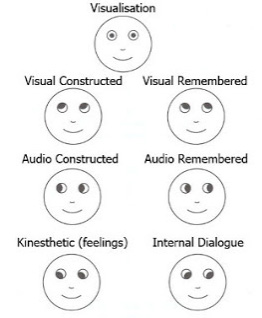
- When making internal pictures people look 1. up and to the left for remembered (eidetic) pictures 2. up and to the right for constructed pictures. 3. straight forward and slightly defocused for certain "visionary like" pictures. Number 3 is mostly not as commonly used as the other two.
- When hearing inner sounds or words people look horizontally to the left for remembered sounds or words and horizontally to the right for constructed sounds or words. People also look down to the left for unspecified access of words and for internal dialogue.
- When feeling internal feelings people look down to the right. Smell and taste also are represented in this area.
Left handed people have a reversed pattern to that of right handed people and then there are a relatively few with other
patterns.
By putting a few of "the right" questions it is always relatively easy to if needed "map" the pattern a person have.
When we communicate verbally the eye movements are always more or less matched by words in the same sensory area.
- When making internal pictures we use words like "se; wiew; picture; vision; seems; clear;" etc.
- When hearing internal sounds or words we tend to use external words like "hear; listen; sound; tell; speak" etc.
- As for the feeling area we use words like "heavy; grab; handle; feel; grip;" etc
If you combine looking at a persons eye movements and listening to their choice of words it is always possible to know which of these three sensory systems that are at work for the moment. Changes can be fast, but we tend to use patterns that are rather individual.
Thought patterns
When we organize our thoughts we usually do this in two or three steps using three different systems.
1. Our "leading system" access some information for example a picture.
2. After this we might access associated information for example some internal verbal commentary to the picture. This is called
the "representational
system".
3. Lastly we go to our "reference system" to check for validity/internal conclusion for instance by checking if it feels right.
If you have a two-step strategy you have a leading system which is the same as your representational system and then you do the step 3
referential checking directly after step 1.
Example: If you ask someone how to spell a word there is an interesting pattern which according to Grinder and Bandler
all good spellers use. It is a two-step strategy:
1. They access an eidetic, remembered picture of the word.
2. They check this picture kinaesthetically.
Accordingly the typical pattern for a "normally organized" right-handed person is to:
1. first look up and to the left and then
2. down and to the right often with a small confirming reaction connected to the "feeling check".
According to Grinder and Bandler all other spelling strategies results in bad spelling even if some strategies are better than
others.
One typical strategy which really bad spellers use is to begin with hearing the remembered sound of the word internally and then try to
check it out in one of the other sensory systems.
Internal maps and associations
During his or her life every person builds up an internal "reference system" consisting of experiences, memories conclusions and ideas.
We all internalise what we experience. It is however important not to believe or think of all our memories as reality, since they
are of course not. They are only our own representations of reality and they can sometimes be heavily distorted.
In our daily life we use our inner references and reference system as a map. We compare it with what we experience today and use this
comparison to orient ourselves and to choose how to interact with other people and the world around us. All our memories in this map are accessible
through and associated with one or more of our sensory channels. When we communicate our senses always trigger and relate to internal associations from
our "map." These associations are mostly functional. Sometimes they are however not very constructive to use for interacting with others but we use them anyhow.
There are a lot of different individual strategies for how we typically organize our thoughts. Some however in each given situation works better than others.
Helping people with personal problems to organize themselves differently and more functionally is one part of what NLP is all about.
Helping people to be less bound to and give alternatives to "bad associations" by giving them new constructive and positive ones are
another area where NLP is very effective.
Matching
Matching or pacing is an important part of NLP. This is not a totally new idea or strategy but in NLP it is refined and more subtle than
in any other technique that I know of. This has its base in the fact that NLP is both very systematic and gives very thorough information
to its user.
Matching or pacing means to adapt yourself and your communication to someone else(s). This is very important in all communication, and
people often match each other subconsciously. When done consciously it is however very effective and can be a powerful tool for getting
the outcome you want. When used in psychotherapy matching is often necessary to use to get in contact with the client and to have their
confidence.
Many psychotherapists use pacing as a natural talent without thinking about it. Others use it more consciously.
To match or pace someone you should mainly adapt to their body language and to their choice of words and tonal patterns.
Doing this without being obvious will help to get in contact with the other person. When done more systematically as is
possible with the use of NLP, you notice how people communicate by looking at eye movements and listening to the choice of words and
notice the choice of sensory system and then you combine this knowledge with noticing body posture, tonal patterns, breathing etc.
When done in a proper way this can allow you to lead the conversation or communication. As soon as you by pacing get good contact
or "rapport" you are able to steer the communication your way if you wish to do so.
In psychotherapy this allows you to help people change the strategies they use to communicate and to change how they use/organize their
sensory systems and associated thoughts. What is relatively easy is for example to help people who have a dominant sensory system
to open up to using the other ones more frequently as well. This is good to do since everyone need to have easy access to all three of the
mayor sensory systems. One way to do this is to pace the sensory system a person uses and then link to one or more of the others.
Done rightly and in a way that "anchors" this link within the other person it has lasting effect.
Another thing that is relatively easily done is to help a bad speller change by teaching him/her to use the right accessing strategy.
Important in all psychotherapeutic work is to first notice what and how people do to communicate and how they organize themselves and
then by pacing, linking and other means help them to change.
When and if you use NLP you should realise that it is a powerful technique which used wrongly can be manipulative and hurt both the user
and persons he or she tries to manipulate.
NLP and hypnosis
As mentioned, NLP is a very potent method and for the skilled user it is not at all difficult to use it for trance induction and hypnotic suggestions. NLP as a method is designed to allow communication with subconscious parts of a person and when you combine this with inducing a trance it is possible to manipulate and deeply affect people without them knowing or being able to resist.
Milton Ericksson who as a person has had great influence on the development of NLP was a very skilled user of hypnosis. John Grinder
and Richard Bandler were or are, when they choose to also very clever even if maybe not as skilled as Milton Ericksson.
When working with hypnosis good pacing is absolutely necessary. When pacing successfully you are able to lead conversation/communication
and then it is not difficult to induce a trance if you have the skill. I will not go further into this since it would require a more
thorough account of NLP than this book gives. Instead I recommend you as a reader to find and read one or more books about NLP and trance
work.
I will however add something about hypnosis. There are many people working with this kind of techniques in a more superficial way and you
can find a lot of examples of this for example in You Tube. What you can however find this way are mostly methods for deep relaxation
combined with different kinds of suggestive messages to help with different kinds of problems like for example better sleep and to be
more relaxed and at ease in different situations. You might also get help to overcome problems like to stop smoking or with weight loss.
Most practitioners use hypnosis in this more superficial way and it can be very beneficial and helpful.
Real or genuine hypnosis can however induce a trance where the hypnotised person is partly "taken over" by the therapist or hypnotiser
and the hypnotised person will also mostly not be aware of what is happening during hypnosis. This is something different than deep
relaxation.
It includes imposing your will on another person and hence it is much more than just giving deep suggestions. To do this craves
more skill than just using suggestive techniques AND it can be a bad thing to do if the hypnotised person has not agreed to what is
happening.
This kind of hypnosis is much more potent and it should be used sparingly and only when help is strongly needed. Another thing is
however that "modern people" in more "developed societies" are not easily "taken over" in that way. The reason for this is that humans
who are well educated and "filled with" information from education, television and other sources and who are maybe living in complex
societies have a more stable and fixed connection to their perceived reality than have those with less input of the kind of information
which make structure and put the percieved world in order.
My personal views on NLP
I studied NLP around 1980 as part of my continuous training as a Gestalt therapist. My training as a Gestalt therapist
had already made me rather skilled at using myself and my communication as a therapeutical instrument. I was however very fascinated
by NLP and in those studies I got a deeper and wider understanding of how to further adapt and use my own communicational patterns.
I also learned some very useful new techniques and acquired other very useful knowledge.
Little by little I started to integrate my new learnings in my professional work to the benefit of myself and my clients.
However NLP also gave me different kind of impulses and understanding. I became very much more conscious regarding the limits of
and the problems with manipulative techniques. I looked with partly new eyes upon Gestalt therapy and the rather extensive manipulation
that is or was at that time sometimes part of this therapeutical concept. The result was for my part a rather radical change in relation
to psychotherapeutic work, my own as well as others.
As I see it it is important to have great respect for the type of communicative techniques that NLP represents. They are very useful but
must be used with great care. Carelessness strikes back on both client and therapist. It can as a matter of fact it be even more
risky for the therapist.
It is almost impossible to live an ordinary, healthy and sound life if you fall into the trap of using this kind of "therapeutical
glasses" and these tools for change in your ordinary everyday life. If You start to involve and use these techniques in your personal
life you will very likely alienate and isolate yourself from friends, family and colleagues. I have seen this happen and I believe it is
very difficult to reverse this process of alienation.
As for myself I have made my choice and I use this kind of techniques only in my profession in my work with clients and groups and even
then I use the more potent techniques very sparingly. To do otherwise would be as bad as if a surgeon would walk around and wave with his
scalpel outside his operation room.
NLP and magic
It should be obvious to the reader why I choose to write about NLP as part of the subject of magic. NLP is as potent in the area of magic as it is when used more "normally" doing psychotherapy. Some of the learnings that NLP provide are necessary for a person who chooses to open up to magic. These skills are of course not new. On the contrary they have always at least partly been part of magical teachings and training. With NLP much of this knowledge has left the often secret learning field of magical tradition. NLP also gives partly new knowledge and structure which makes these things easier to learn.
There is a lot more to NLP than the above and I therefore recommend you to read one or more books about NLP. The title I especially recommend for beginners is "Frogs into Princes" by Bandler and Grinder
Eye movements
There is a need to say something more about eye movements.
In Nlp there is a lot of new information, knowledge and
insight about the importance of our eyes and the communication that is connected to our eyes and how we move them.
However knowledge about the importance of the eyes and eye movement is not at all new. There are many methods connected to eye movement
in the traditions of so-called primitive tribes. In shamanistic knowledge and teaching, training connected to eye movement has been a
method for helping pupils to get more integrated and to get insights about how they function and about their own minds and bodies.
Rotating your eyes, defocusing your eyes, moving them diagonally or in other patterns has been known to be of importance for personal
development and to be able to know more about yourself and the way you function in deeper parts of your self.
In modern psychology these methods have in recent years been rediscovered and integrated as a method to work with change and personal
development.
The most important use is to help to unlock and discharge trauma. This function is actually a very effective way of using eye movements
for helping people.
Rotating your eyes or moving them from left to right or diagonally or in some other patterns can help to open the communication between
the two halves of our brain. This effect is a result of the way our eyes are functioning. The optical nerves are crossed in a way that
makes the eyes a gateway to opening up communication in the brain.
When whe are traumatised the communication between the two halves
of our brain is interrupted.
The memory of the situation and experience connected to and creating the trauma gets locked up in a circular pattern and this makes the
experience difficult or impossible to put away and to make it an integrated part of our memory which we can leave be. This circular
pattern and lack of communication from left to right is the way a trauma functions and when opening communication between left and right
the blocking function can be repealed and the trauma can be discharged and then be integrated as a more ordinary "memory" in our
history/luggage.
When a person is very seriously traumatised the interruption of communication in the brain might lead to partial or total loss of
connection with what has happened. The memory gets locked up and put "safely" away mostly in our right half of the brain.
This "safety" is of course imaginary since the effects of the trauma are still there disturbing the persons life, sometimes making life
very difficult.
When unlocking such a trauma you must be prepared to work with the memories coming back to your awareness. Professional help to do this
is most often needed.
There are layers upon layers of thoughts in our mind
When reading through the text below I find that I sometimes have difficulties to describe things. The things i describe are however very difficult to put into words sometimes and when you read this it might seem as if it is something not very complicated. To be aware of your deper thoughts and maybe affect them is however very difficult and complicated even when you know how things should be done. You as a reader will have to do the best you can to sort out things and understand things as I have done my best when writing this
Our thoughts govern all that we are and everything that we do.
Our mind is very like a computer and your consciousness is like the mouse,
touchpad and/or keyboard working on the interface/screen constituted by our conscious mind.
This means that our conscious mind at least theoretically can govern everything
inside our mind as long as it has full access and knows how to do so.
Most people have very limited access to what is inside their mind AND to the methods for working with material and programs on the deeper levels. To really be able to change things you need to be a “hacker” and as hackers need to know a lot of things about how computers work and about programming. You also need to know similar things about the human mind to be able to “hack your own mind”
There are many layers of thoughts inside your mind, like programs inside programs in
a computer and the deeper and more rapid layers seem mostly to govern the slower
thoughts “above” which are closer to our awareness. Some thought streams also seem to be more parallel and to
sometimes work on the same level
Lately there has in modern psychology appeared more awareness in this area.
The book “thinking fast and slow” by Nobel Price awarded Daniel Kahneman is such
an example.
There is however more to this than just fast and slow.
We actually think slow, less slow fast, faster, very fast and…...? instantly?
If you work on your awareness and the ability to stand aside in your mind and "look at" or observe your own thoughts it is actually possible to notice the different layers of thoughts and to be aware of how your mind works and how you think.
Most people are aware only of the slow way of thinking that is “on top” of our
awareness. Most people are also stuck in these thoughts in a way that they can
mostly not stand aside and notice their thoughts in a way which makes it possible
to affect them very much.
Most of us howver have moments when we suddenly are aware that we follow a line of thoughts and
maybe wonder how we ended up thinking on a specific topic. We sometimes then also
follow our thoughts backwards to where a certain chain of thoughts seems to have
started. These moments are valuable. Very much so actually and they should be
cultivated.
This cultivation of your mind and awareness is what you do in the more powerful
methods of meditation even if you then usually don’t go back in the thought line but
just stay in the place of awareness where you can as if from the outside "look at" and notice what you think
and feel.
Meditating this way you can little by little be more aware and learn to stand aside
and look at and notice more and more of your thoughts and also be more aware of how thoughts and feelings are connected.
Following this path is parallel to more and more being able to from the outside "look at" or experience your bodily functions,
your perceptions, inner sensations and inner rhythms. The more you develop this ability of "standing aside" the less you are a victim of
what you think and feel.
There is a trap here for those who think that it is enough to look at thoughts alone.
As I just mentioned your body, your internal perceptions, your feelings and your emotional
self must be part of your studying if you are to be successful. Your body is a gateway and to navigate your internal world
your body is in a way even more important than your thoughts. Your body is also your "anchor" when navigating thought patterns and
thought streams that are mostly subconscious.
Inner sensations, feelings and emotions are as important as thoughts and are actually an integrated part
of thinking at least for us humans and probably also other biological beings here on this planet.
It is very important to point out that feelings, emotions and attitudes are so much integrated
with your thoughts that you cannot master your thoughts without knowing and mastering
your feelings, emotions and attitudes as well.
Hence the way to reach deeper levels inside your mind goes NOT by just
focusing on your thoughts BUT on focusing on your body ad its perceptions and on your
feelings, attitudes and emotions. This way you will also in time reach your deeper normally subconscious
thoughts and you will do it in a way that makes it possible to alter them.
All sensations in your body can be helpful when learning about your deeper self but
your feelings, your emotions are absolutely essential. Your feelings, attitudes and
emotions are also like keys in the sense that they lock or unlock your fixed thought
patterns.
The superficial thoughts that most people are aware of in their daily existence and to which I refer to in the process described above are something that most people can notice rather easily. These are the slow thoughts which constitute the upper layer in our awareness.
Continuing the described path of standing aside and take notice of thoughts and feelings you will gradually notice
and learn mor about the different layers of thoughts in your mind. You will also more and more be in a place where
your mind seems in moments or periods to be still, like it is without thoughts. You will then also realize how
extremely difficult or nearly impossible it actually is not to think at all.
In this place in your mind you need to have an anchor, something that you can use as focus. In Zen practice this
anchor is usually your body and your awareness of breathing. At least this is so for
most practitioners. Later in the meditation process your heart and its pulse might
be at least as important as your breathing or even more so. Referring to what
I have written earlier it is so that the heart is the most important focusing and anchoring point there is and that
is because the heart is our most safe place and it is also a link between heaven and earth.
Because of that you need the awareness of your heart bodily as well as mentally and
emotionally to be able to navigate properly in the deeper layers of your mind.
In your place of stillness where thoughts can seem vacant you will be able to experience the rapid thoughts. The thoughts that arise so quickly that you don´t know that they are there before they have actually manifested and had effect on your awareness your mind and your self-perception. You might also get to see that there are more rapid thoughts and less rapid thoughts.
The more you notice thoughts and their content AND their effect on your feelings the
more obvious it will be how great their impact and effect is on your self
and who you think you are and on your actions. You will also realise how much they affect
your view of others and of how you perceive the "reality" that surrounds you.
You will little by little be more aware of and notice the different thought processes and that there are
actually like layers of thoughts and that your ordinary slow thoughts are just like the top of an iceberg.
You will eventually come closer and closer to see that very often you make decisions and
conclusions very very quickly and that you do this in a part of your mind which was earlier
not available for your conscious mind. This part of your mind is in my experience where so-called
intuition originates. You perceive it consciously as if you just know things.
However now being more perceptive you will maybe "see or notice" that you actually process things in
this place but very, very quickly and that you make judgements and conclusions and
often also decide things but so fast that you cannot follow it the way you do slower
thought processes. Deep deep down you might even get to notice the processes that
constitutes, shapes and upholds our "reality."
There is more to say about intuition. In line with what I say in the former text what we call intuition is actually very often conclusions or decisions that we make ourselves but so swiftly that we feel or think we just know something. There is however more to this. Intuition can also very often be due to our contact with the collective awareness/consciousness that we share with other humans and also with animals and other parts of creation. I would say that this collective part is sometimes maybe even more important as part of what we call intuition and there are also mixtures of what we pick up from collective areas and our own rapid thought processes.
To work actively with your rapid thoughts is not easy and takes long training. If you want to work with these rapid thoughts more actively you will have to make packages of your thoughts. That is, you might affect the content by learning what is in there, by learning what they are about and what the effect is. You might then alter this by making a different package and make an exchange. It´s in a way like you have labels telling what´s inside so you can choose which package you want but this is of course a simplification. The labels are connected to a feeling /sensation in your body that goes with it and mostly you have like a picture or a metaphor that you use as a label. What way you do this is however very personal and sometimes the "label" you use is just like a kind of feeling inside which you know has a certain content . Working this way is as I said not easy and my description is just the way I experience how things are and I must point out that working with these deeper thoughts is NOT something I do more than very seldom. It takes much effort and to stay that deep for long is not something to recommend and I do it only when it is strongly needed.
To make you understand better I will do my best to give examples.
There are thoughts within thoughts, within thoughts...... Everything is built up of thoughts,
meaning that if you for instance think "wall" or "boat" or "consciousness" you have once learnt
the content of these words, what they mean and stand for. This content is built of "tinier" parts
or "thoughts" in our mind, which in their turn is built up of even "tinier" parts. It is not much different from code
in a computer. Our subconscious mind reads these thoughts/parts very very rapidly and you just know what a "wall" is.
The similarity to a computer is almost frightening. Your mind is like the processor and your conscious part as the screen.
You can also think of this as if in your deeper mind there are complex programs that handles other programs which in their turn
handle other often less complex programs and so on. Because of this you might on deeper levels only need to give simple commands to
make a lot of things happening.
What I mean with labels and packages is exactly the same as when you think of "wall" and just "know" what it is.
It is also about giving commands consciously where you before did this subconsciously.
You can consciously build something in your mind that has a content that you know and you can label it with some kind of
association that makes it possible to reach the whole content instantly. You can also break down
known things by investigating and realising what the content is and change it by removing and/or replacing something.
As an example think of a fruit like an orange. You just know its colour, its texture , its smell, how it feels to hold,
what the shell is like when you peel it, how it looks inside, the sound when you squeeze it,
how the taste is and so on. You have learnt this and built up this
knowledge partly with your conscious mind but mostly with your subconscious mind. You have used your senses and your
brain to do all this and you have an inner knowledge saying what an orange is. This knowledge has different inner
sensations connected to it and different maybe in this case mostly positive feelings and memories.
Aside from oranges there are rather similar fruits like grapes, clementines, nectarines and
maybe more. They are rather similar to look at and sometimes it is hard to separate and orange from a clementine.
The content is however different and there are also oranges with slightly different content from other oranges.
When you now realise how much of underlying information there is connected to an orange you probably realise the
complexity of this fruit and also that if you change for example the taste of it it will be almost like something else.
There are probably persons having very negative associations with oranges due to how they have learnt about them.
If you could go into the content they associate with it and replace the bad/negative associations with positive ones
you could change the whole meaning they give oranges in their life.
As another example, take an ordinary almond.
I think most people find them likeable. Then there are bitter ones looking the same to the eye. The bitterness
is part of the bitter ones because of them having cyanide inside which is also very poisonous. If this would be two rapid
conclusions or "thought packages" in your mind they might look alike but have different content and give you a very different view
of the thing or phenomenon they represent and maybe also for your self-image.
When you consciously change things in your mind one can think of it like you have one package saying bitter and one saying sweet and
you remove the bitter one from the almond and replace it with the sweet. If you have no labels like bitter and sweet
this would be a very complex thing to do but using labels it is possible because everything inside bitter goes away with
the label and everything inside sweet comes with this label. In your mind it is however often not names but pictures or images and
sometimes even a bodily feeling or sensation that are more constructive to use. That might depend on who you are and your own preferences
BUT in my opinion pictures or images are mostly better than for example inner words or sentences since they can contain more information.
Important is as I have pointed out that the whole inner feeling and sensation goes with the label. I must point out this again. Your senses feelings and
perception are absolutely essential when working with your mind.
I hope these examples makes it easier for you to grasp what I am trying to say. What I describe is extremely complicated and
I cannot say that it is something I can easily do well, but I have an inkling of how it must be done.
It is very difficult to describe but even so it is very important to try and make this easy and not get trapped in details.
To change bitter to sweet you don´t need to touch the appearance, texture, colour and sensory perception of the almond. You just
change one aspect where the package itself might have a complex content without needing to touch the content to be able to get to know all
the parts it is built from. To consciously know all the parts in a package like this is probably impossible
To make this more understandable just think of what our language actually is. Every word is actually a label.
Every word is filled with meaning and the content can be very complex. There is however a problem with using words as labels for exchanging
content in our programming. This is due to the fact that our language and our words are often filled with content that is complex when
it comes to its meaning and not seldom also filled with different and/or counteractive meanings.
There can often be both positive and negative content in the words we use and associations connected that might mix
things up. This can be a fact even if we think we know the full meaning of the word. To use labels for changing the content of bad
programming simplicity is important.
You can however use ordinary words if they are filled with meaning without contradictions. Actually a 2-word sequence is very potent
as long as you are certain that the content is without contradictions. If you are not certain about this you should use your own
labels filled with the meaning you have put there and which is as close to 100% clear and positive as possible.
From what I have said here it is obvious how important names, associative learning and labels are.
All learning is actually associative and when you learn your whole being is involved. Everything you experience is mostly absorbed with
all your senses. Thus, ALL memories that build up your world have once been connected to an experience in your body and not
just a thought in your mind. To undo and to change learning in a deeper sense associative methods must be used and you sometimes
need to revive and relive the experience in your body connected to the original learning before change is possible.
Labels and associations like names and pictures and the sensations that goes with them build our world. Without them we would be lost and loose order and connection to order. In modern psychology there is actually indications that if we have no label or name for something it might eventually not be there for us to perceive. I don´t know if this is true but the mere fact that it can be so is worth consideration.
The habit of making conclusions and judgements about yourself and about others and about situations and circumstances is not seldom a part of your slower thought patterns and it might be there that you can more easily discover how frequent this is and how much it affects you. This is however a complex thing and some of these judgements and conclusions are active in several of our thought layers and because of this some judgements and conclusions are very very rapid. This is especially true when it comes to judgements and conclusions about our own person since they are part of our own programming.
As for being able to stay in the deeper and more rapid processes you MIGHT eventually be in a position where you can affect the intuitive parts in your mind. At least you might get better at knowing the reasons for and origin of part of your intuitive knowledge. You might also realize that intuition in fact as I have told before at least partly originate from your own thought processes.
I wrote the paragraph about our thought patterns around 2015. What I have discovered is the result of my own inner experience, mainly during meditation.
Working with psychotherapy and doing Tai Chi for many years might, however, have added to my ability to notice more about how we think.
The method I use for meditation is Zen meditation of the Soto tradition. This is a very clean and simple method, and I have described it earlier in the text.
There has been a development in my experience, and after some time I did not have to sit down and meditate to be aware of the different thought streams.
To begin with, I noticed that there is, at least most of the time more than one line of thought going on at the same time, and at first I noticed that there was one
more line of thoughts which was more rapid and in a way seemed to "lay deeper down" in my consciousness. After some time I noticed a third, even more rapid
line of thoughts, and later that there are even more extremely rapid thoughts going on on a deep level where it seems as if they are almost instant.
My experience of rapidity is, of course, just related to how I am used to experience thoughts and depends on my own ability to notice what thoughts I experience.
Compared to, for example, a computer, even my rapid thoughts are extremely slow.
For some time my experience was that each of these thought streams was "deeper down" the more rapid they seemed to be, and the one that was extremely rapid
was the deepest. It also seemed as if the deeper thought streams were, in a way, affecting those above, almost like how programs in a computer can govern other
programs, and at the "bottom" there is a main basic program governing the system which makes the computer function. The very rapid and instant thought stream
seemed as if this could be where we experience what we call intuition. I also, in time, realised that there also seem to exist more "parallel" thoughts going on at the
same time.
My experience has, over the years since this all started, changed a bit, and I have more and more discovered that how we think is even more complex than what it
seemed to be, and that it is not static but can vary from time to time. There sometimes seem to be several thoughts going on without one being more rapid than the
others, and what earlier seemed to be four separate levels is at least sometimes more diffuse, and there might be more than four levels, but where thoughts are
almost instant this is very difficult to say for sure.
Gradually I have also become more and more aware of how we (or at least I) make almost instant conclusions about much of our daily experiences, about things
that come to our awareness, and about people we see. It seems as if I, and probably all of us, are judging, confirming, and making conclusions about persons,
things, and our ongoing and earlier experiences constantly, and by doing so we add to the way we define and experience reality. This is going on all the time when
we are awake, and it mostly takes place in the more rapid parts of our thought patterns. This ongoing process is probably necessary, but it is also filled with
confirmations of our prejudices and what we think we know about life and "reality" based on our earlier life and experience. Although this process might be something
we must do to define and build a base for our existence, there is a problem connected to this activity, namely that we, or at least I, seem mostly to confirm earlier
experiences and sometimes make judgments and conclusions which are not very constructive, but often add to inflexibility and sometimes rigidity.
The process I describe is mostly very rapid and totally subconscious, but it can be subliminal, meaning that it sometimes might be very close to the threshold of
awareness. We are for example sometimes aware of the resulting confirmation or conclusion which we experience and define as "this is how it is." We are
however mostly not aware of the fact that the conclusions actually are a kind of decisions which we make and not due to facts about reality. We are thus also not aware of the
fact that we are all of us, in our daily life, actively rebuilding or confirming the reality we experience.
When becoming more aware it is possible to affect our daily defining, judging, and concluding. Since most of this goes so quickly it is not easy to do, but if you learn
how, it will make you more flexible and less rigid and less certain that what you think about life and reality is "right" and a fact.
The most rapid thoughts that I have discovered are even more difficult to affect. It seems as if those thoughts are mostly connected to the experience of our self, our body, and our basic awareness of ourselves and life. I think that it is in the very rapid thoughts which are deep down in our being that we also can affect and maybe change things both in our body and our perceived reality and to succeed in affecting those thoughts one has to be subtle, very soft, and most often very quick. It has to be done by affecting the outcome of a thought process or conclusion and changing it before it is confirmed, which always happens by ending it with a bodily sensation or feeling.
Intent
The further/deeper you go into your mind the closer you get to what I call intent. I don´t really know what
that is and the little I know is hard to explain.
It is just something that is there behind or inside your self-awareness. It
is like when you move your eyes from one spot to another. You just do it and mostly
you do it as a reflective answer to something THAT HAPPENS OUTSIDE yourself. It is reflexive and not
something you normally think about as something you can or need to control
BUT there is a place where you are able to take control and decide where to look and get in control of almost
everything that you do and this part of your awareness is where intent is housed.
I feel somewhat at lost to describe the deeper parts in our mind. Awareness itself MIGHT or IS eventually constituted by very deep thought processes and maybe it is in fact so that you always have thoughts going on even if they seem not to be there. They might be like more or less fixed in your mind and perceived as manifestations just being there but you cannot reach the place in your mind where these eventual thoughts arise which are creating these manifestations. Hence awareness itself is just being there or not and when delving in the very deep thought layers senses, perception and stillness are your main and maybe only tools and also your anchor.
As I have pointed out above it is also so that going deep enough, we reach the parts of our mind that are intermingled with the consciousness of others. This is where thought layers exist which are often called the collective consciousness or collective mind. In these parts there is a natural limit to your possibilities to take control even if influence is possible. There are those who might eventually work here and who can influence to some extent. Much control is however hardly possible since the complexity and options are so vast. Aborigines in Australia and New Zealand call this part dreamtime and traditionally they have had more conscious control here than we from the west. However unconscious or subconscious influence due to strong common beliefs in a strong culture or religion can have as much effect or even more so in these layers than have conscious influence.
One important thing about dreamtime is that it is not only human consciousness that is important there, but the consciousness of all beings AND very important is that also non biological creation has its influence here. Consciousness is namely in everything around us. Such a belief is far from what western science and our main belief systems and religions can accept but it is still a fact.
Dreamtime is not where we go when dreaming. It can of course be but when dreaming you mostly
go to the place where EVERYTHING is connected not just the earthbound
parts of us. Because of this, dreaming is the most powerful tool of all and
conscious dreaming is where you can navigate eternity with some small control.
Your own body is your anchor in ordinary dreaming, but to also have your heart as anchor is,
as I have said before also necessary if you do conscious dreaming otherwise the
risk of losing yourself can be very great.
About locking and unlocking thought patterns
Since your thoughts govern all that you are and all that you do you need to be able
to find a way to master them if you don´t want to be their victim.
The thoughts that govern your being, your prejudice and your behaviour are locked in
patterns in your different programs or layers of thought. The thought patterns are
fixed and what locks them are your feelings, emotions and attitudes.
If you are aware of the way your mind works when awake you
might notice that you make conclusions almost all the time all day. You confirm
things that you think you know and you conclude new things and this happens very fast
and very often, actually almost all the time you are awake.
As an example just think of how often you make judgements and
conclusions about the people around you. You see a person and you think you “know”
what this person is like just by a quick look and often you make a quick judgement
about the person. You might also notice that there are
always feelings involved here. You get a “feeling” of who this person might be.
The judgement or conclusion is based on your experience and learning and you have
gone through the process of building up you experience this way to be able to
navigate being a human among other humans.
These judgements and conclusions about
others are however often very superficial and they can be very, very wrong.
The least you can say is that they are limited and that they limit yourself even if
they also often help you to “navigate” your life.
Having your awareness on your mind and thoughts you will notice that your conclusions
and judgements very often are about yourself. You constantly judge or evaluate yourself
and your actions and possibilities. Actually it is so that also when making conclusions about
others you often end up comparing yourself to others, about who you
are and what you do and judging or making conclusions about yourself as well. All the
time this self-evaluation is combined with a feeling, bodily sensation or attitude.
It can be self-loathing, pride,
a feeling of being better than others, a feeling of being bad or a failure or
hopefully of being good and successful. Actually we are filled with these patterns
about ourselves as well as others.
YOU NEED TO LEARN TO UNLOCK Your fixed thought patterns and avoid judgements based on
prejudice if you want to be more free and more open and since most of what I describe happens in
thought streams which even if rapid are not extremely so it IS possible to learn how to work with "locks"
even if it is not easy.
To open up these patterns you need to notice the very conclusions you do and to
notice when they are confirmed and locked by an attitude, emotion or feeling in your
mind and body.
DON'T try to push anything away BUT just notice and refrain from letting the
feeling that follows your conclusion get set and make the conclusion fixed.
Let the conclusive feeling or sensation slowly disperse
and stay with it till it´s gone or almost gone and instead put a feeling in your mind
about yourself like for example, I am nice and beautiful, I am a loving person
who does not need to make judgements. Important is to use just one such affirmation at a time
and to use one as simple and central as possible. To use affirmations where your heart is involved
as an anchor is in my opinion a good way to keep a proper "balance" and not lose yourself.
All this is to be done very subtle and easy with a very light touch almost like you are petting yourself
inside your mind. No pushing away! NO grabbing. NO judgement about yourself being other than nice even
if you kind of feel it is hard to succeed. It is not easy to navigate inside your thought patterns and
learning comes little by little.
If it feels difficult just have a good anchor that you stick to
like for ex "I have a good heart, I am just wonderful and I just do the best I can".
Let this feeling of yourself being wonderful be the main tool that you use as a
substitute for feelings and judgements that you want to get rid of,
both about yourself and about others.
There is another way of describing how these processes might be perceived inside: When
working to not "lock" a conclusion you might perceive it as if you are "straightening out" your thoughts.
An example: You suddenly realise that you are in the process of making a conclusion or
judgement that you don´t want to do, at least not automatically.
For example, you happen to think about a situation and realise that you start to judge yourself.
"Oh I shouldn´t have done that. I failed" or "I´m bad" In the end of this conclusion there is like a loop
where you lock the judgement. Breathing and feeling are involved in this.
For my part I perceive it as if the loop goes from my brain and down into the body
where a feeling about myself quickly manifests and then it kind of "sets" or
locks up very very quickly. The locking part is always done when breathing out and
the whole process sets at the end of the exhalation and is confirmed with a feeling or bodily sensation.
This is at least true for me and i have a hard time believing that it is not the same for others.
After locking itself the conclusion and feeling involved is included as a part of your luggage and/or it
confirms that this judgement about yourself is true and a part of who you are.
In the short moment when I feel like my thoughts travel "downwards" to be locked up
I just refrain from letting them continue to the locking up feeling and this is where it suddenly feels like
the thoughts "straighten out." It is like you DON´T PUT AN END to this line of thought OR you might put another
end of your own choice if you break the locking up part.
There is also an experience of similar kind with the feeling involved. Since you don´t let
it reach the conclusive "locking" part where it kind of sets inside, you can feel also as if
the feeling straights out staying in a faze where it is less strong but still able to deal
with by letting it disperse slowly or by changing it to a positive feeling about yourself.
Again, I must point out: NEVER GRAB or PUSCH. Just with a light touch of your mind
steer the thoughts away and keep your inner self from doing the "locking". After this you should just,
either let the thought line and the feeling involved fade out into nothing or put another end to it saying
something positive about yourself and add a positive feeling.
To add or replace an unwanted feeling and line of thought is fully possible before the "locking"
takes place in the process described. After the "lock sets" it is almost impossible and you then
need to wait until another possibility arises where your mind touch the same or a similar subject.
The changing of the thought line does NOT mean that you affect what you did that led to this line
of thought and make this act and/or this way of thinking positive but you change the internal
consequences and conclude that you are good anyway and that you have the right to do just as
good as you can. Even if you make mistakes, you are just wonderful and nice anyway.
You should let the positive replacing conclusion go down into your body and let a positive
feeling lock up the process. It does not need to be perfect. Just do the best you can.
The important thing is the lock and the positive feeling about yourself not
that you think right or anything like that. A positive lock or feeling about yourself
like this is NEVER wrong even if you dont think you do it the right way.
As for your life and your actions you will know when you make mistakes
even if you don´t judge yourself and you will be better off correcting mistakes
if you can look at them like something that is NOT a part of yourself.
It is very important not to work too intense with your mind in the way described. Just do it when you notice what´s happening and do as best as you can. THEN LET YOURSELF BE and let your mind be free to go elsewhere. You might maybe dwell on your positive feeling of having a good and loving heart or whatever similar positive feeling of yourself that you prefer, but never grab. Instead, just let things go away easily and then let it be. If you spend to much time in your deeper mind you might lose yourself and end up less safe and secure.
Navigating thought streams.
As I have pointed out most people can perceive one stream of thoughts in their mind but no more. To be aware of more than one you need to
sharpen awareness and train to be an observer, a spectator in your own mind. Important is also that the way to your thoughts goes by
working on better body awareness and focusing on your body and you´re breathing and on feelings and sensations in your body.
The topmost thought stream in our mind is also where it is most obvious that our will can affect what we think.
You can compare it to how we relate to our breathing. Our breathing is mostly just happening without one needing to do anything. It just
happens automatically, BUT you can “grab it” and breathe consciously by using the muscles in your chest and abdomen. In a similar fashion
our thoughts just happen, but you can choose what to think and to actively affect what you think. This is very obvious for example when
you plan what to do and when fantasizing or using your creativity, but it can happen in many different situations and how conscious you
are differs a lot depending on the situation.
It is possible to use your will to affect also deeper thought streams, but to do that one needs training and experience in watching as a
spectator.
It takes training to reach “deeper” thoughts but there might be a “shortcut” to observing your own thoughts. When resting and especially
when close to sleep it is in my experience easyer to be a spectator and watch your thoughts. You might eventually also be able to notice
that there are more than one stream of thoughts when you are in “close to sleep” awareness. I am not certain about how much of a shortcut
this is since I have not started to experience thought patterns this way myself but it seems likely that it can be a way worth exploring.
In my present situation when rather used to observe my own thoughts I am sometimes able to experience and sort out things in an interesting
fashion when I am in “close to sleep” situations. The “best” situations are when waking up in the middle of the night and /or when waking
up early morning when one is aware but not fully awake. In these situations, awareness of outer stimuli is much less disturbing and then
awareness of things happening in our mind gets easier.
If you in “close to sleep” situations notice and follow your thoughts you might be more aware of the fact that you can be a spectator.
You might also eventually be able to realize that you can think about the fact that you are thinking
and hence realize that there is more than one thought pattern in your mind.
Another thing you might notice is that suddenly when sleep is close there might pop up strange thoughts and or pictures like for example
a sudden person coming into view and / or a voice saying something strange or suddenly a landscape appearing. This happens when we come
in contact with our dreaming world when being awake or almost awake. When this happens it is very obvious that we have an inner world
far more complex than just our conscious thoughts.
Being awake but in contact with our dreaming ability is interesting and positive and the more we can explore and learn about the gateway to the dreaming world and how to be aware of ourselves in our dreams the more we might realize how fragile our ordinary “reality” is and that there is less difference between “reality” and dream than most people think there is.
To always be fully self-conscious when dreaming is however in my opinion not something either easy or desirable. It might actually not be
possible for a human. The “world” outside of this reality is eternally complex so there is as I see it no way to be in control in more
than a very limited way. Even if you get some skill in navigating in dreams you need to mostly let go and let dreams just happen
otherwise you will risk losing yourself.
Some control is however an advantageous thing. There is one thing you might learn if you explore the “border country” between
dreaming and wakefulness and that is to affect the outcome of a dream and / or change a dream.
For me this is sometimes possible for example when I wake up and the dream I just have had is bad and I feel affected in a bad way. If I
can let myself rest close to sleep while aware and in control and if the dream is still vivid enough to reach I might go back into the
dream while being in the “borderland” and find ways to alter things.
It is then possible to change a bad situation by letting my imagination free. Imagining is close to dreaming and since in dreams everything
is possible I can for example let myself fly away from something bad or I can bring in someone giving help. I can make a monster suddenly
vanish in an abyss or let myself get superpowers. Whatever is needed and can be imagined is worth trying. Trying this you might
end up getting more and more awake sometimes but even so the dream will have lost some of its negative power.
There is or at least was before our “civilization” reached them an interesting culture in central Malaysia called the Senoi people. They
worked actively with dreams as a central part of their life. Children were from an early age taught to get in control to make the dreams
positive
It is said that the Senoi did not suffer from neurosis or psychoses which might sound hard to believe. But this fact is said to be well
researched with results confirming this. The way they handle their dreams seems to be the key to this.
You can find more info about the Senoi on the internet. Here below is one link
https://www.malaysiasite.nl/senoieng.htm

About reality
Is there a fixed reality?
Is there a common reality?
Is there even a reality at all??
Are there other realities, maybe an endless number?
Is reality maybe changing with the viewer and /or changing because the common view develops and changes?
Are there other dimensions bordering to the one where we live?
There might be many more questions to be put about the nature of reality, and maybe? there are many answers? At least more than one.
If you have read what I have written so far you will most certainly be aware of the fact that our view of reality and our bonds to our perceived reality are central subjects about which I try to give more light.
To start with I need to say someting about perception. Perception is just perception and nothing else. What we perceive is NOT the same
as reality. Perception just makes us able to make a map which we need and must have to navigate our existence.
What we get is however just a map and what we perceive is NOT reality at least not in a way which makes it possible to say
that "this is it" or "this is the way reality is."
Our perception is very limited. If you think about how it is for a dog the map must be very different from ours. Smell is for example a
very important part and in what other ways it differs we can only try to imagine but never grasp fully.
I have another example. I have given you some info about our deeper thoughts and thought streams and I have among other things mentioned
the thought streams which we perceive as very rapid and which at least partly has to do with our intuition.
These thought streams are however of course not rapid in an absolute sense. Someone perceiving things differently from us
could very well find them rather slow and easy to follow. The "rapidity" is just our own conclusion due to our limited perceptivity and for almost
everyone these thoughts are only perceived as a kind of knowledge or conclusion about something which we dont know where it comes from.
Let´s look at the basic things concerning our "map" from my view on the subject.
We humans order everything and we give names to everything. However when you think about names you must realize that name giving has
developed under a long period together with the development of speech and social structures. A very long time ago there were no names.
How is the difference in perception when you have/know a name and / or when you know the function of a subject and its place in
it´s natural surroundings? compared to perceiving without having a name and without knowing much or maybe nothing about what you perceive?
What difference is there when you have associations already built up in your brain due to your own upbringing and personal development?
compared to knowing very little or nothing?
Think about a flock of chimpanzees and then a flock/tribe of early humans and then a small community of isolated Indians in the Amazonas
and try to imagine how their reality must differ from ours. The systems used for perception might be similar or almost so, BUT how we
experience what we perceive is probably very different as is most of the associations and conclusions that are made in those different
cultural circumstances.
Imagine how it must be when there are just you and your tribe and forest and animals and there is almost no order in the perceived
reality. No names and no system. Everything is just smells, sounds, forms and colours and there is life of different kind all around you.
You might have to be very cautious and in preparedness all the time. Your basic instincts and reflective learning are maybe the main
tools you have to live a successful life. Try to imagine how enormously different life must have been.
The world will be shrouded in mystery and at night there are only stars and maybe the moon giving light.
Maybe under those circumstances your perception, your senses could register things which now are hidden because in our ordered life
they have no place?
Maybe it is so that “reality” will change the more you order things and the more you name things and the more you learn about the place
and function of things and maybe when all mystery has left we only see what we have in our common development sorted out as being real
and maybe there are things there but we don´t see or perceive them. It could be so that reality gets more and more fixed and stable the
more it is ordered and systematized. If that is the case “reality” might change continuously and especially might this be the case with
the borders of reality.
On top of naming and ordering we have the way we place things in a time frame.
In the western world we count the “solar rings/circles” from a claimed birth date for Jesus Christ. There was much fuss about the coming
of year 2000 and what might eventually happen as if 2000 would be special in spite of just being an invention. In the medieval times it is
said that many people believed that the world would end year 1000.
Every new circle around the sun is just another circle and how we name or count them has no connection to “real” facts but invented such.
Other cultures than the Christian order these circles differently and it is just a way to order time and nothing else. To order time is a
way to make communities be more stable and easier to govern. It also serves to make our historical background easier to use as a reference
in different manners and when it comes to perceiving our environment it is of help in ordering and systematizing.
Hours and minutes and seconds are just other invented things or systematic pieces which are very important for us BUT in themselves mean
nothing. The circle of the sun is actually more “real” since it can be perceived and registered as an ever returning rhythm in life
the same way dark and bright, day and night comes and goes.
If reality changes with cultural development and ordering and systematizing and especially if the borders of reality does it might be so
that perceived reality gets more and more “narrow” in one way at the same time as we make it “wider” in another way when we expand our way
of ordering systematizing and naming. This could be the case because ordering and systematizing and naming makes borders very fixed and
stable and then we might or will not perceive things outside the borders we create.
You should also realize that our perceptive abilities are very very limited. There are an enormous number of stimuli for which we have no
perceptive organ and or where our organs are insufficient. Think of a dog and the ability to smell or an eagle and vision or a bat and sound. Deep in the
ocean at several thousand meters there are animals and plants with senses we don’t know much about and what about eventual beings in other
parts of the universe and on other worlds?
When you think about all the above it is obvious how we actually create our base for the reality we experience by ordering and systematizing
and that we make it possible to in our brain make processing easier because of the order we create and then we see/ experience reality as it
will look or as it “seem to be” as a result of our own cultural and social development.
Another thing is that reality even if we build it up and maintain it collectively in the end is a totally personal thing. You cannot know
for sure what´s inside another person´s mind and how another person perceive and experience our common reality. You can just believe and make
assumptions which hopefully are correct enough to make your social life function.
That said I realize that there at least seem to be very many similarities. I work as a Gestalt therapist and my own experiences and my own
references are important in my work since they make it possible to during therapy sessions understand what happens inside people who come
to me for help. I think or “believe” that I am right most of the time and at least I seem to be right enough to make what I do as a helper
function well enough to make people feel more safe and happy and learn to manage their life in a better and more successful way.
To be able to use my own experiences and inner learnings as an instrument I however have had to learn to disconnect from and be less bound by them.
This means that I can “see and feel” how my inner programming has a tendency to govern my life but by disconnecting I can refrain from being
controlled and I can often consciously choose how to react and what to do. The way to learn this is not easy and it is the result of much
personal work in psychotherapy, meditation and other methods for personal development.
I describe this use of my own inner programming to make a point. Even if each person has his or her own reality, we also have a common one
and we have built a common ground which functions relatively well. The functioning of our common ground is however NOT the same thing as
proof that we perceive reality the same. It is the learning how to act and react to stimuli and perception which constitutes
the common ground.
There is something more to add about naming and that concerns naming each other as humans. As i have said names are just names, labels that
we use for ordering things and being able to separate things and think and talk about them in a structured way.
It is important to realise that your own name is also just a label and NOT you.
Your personality does not origin from your name even if you might be very much affected by it. If you think of your name as who you are
you limit yourself and also confirm that you are no more than a product coming from the people who have given you your name.
Usually this is your parents. I must point out that you are not their creation or product even if they have had a very big
influence on who you are.
You are something more than both your name and body and to realise this is an important part of freeing yourself from your internal
bonds and programs. When you accept this you will be much more free and this acceptance can actually be a major "bond loosener" which
weakens other internal bonds.
It is important to point out that realizing and accepting that you are not your name but something more does NOT mean that you love your
parents less. On the contrary you will be more free to love and accept them.
Our brain is the central processing part in our body. It is where we order and systematize our world.
The difference between the two halves of our brain is however almost total with the left half systemizing most things and the right
processing feelings visualization imagination and other functions where system and order are not central. As the two halves of our brain
govern the opposite sides of the body this means that the left half governs the right side of our body and vice versa. Even if the halves are connected
and both bodily halves can work together we are two sided also functionally in some basic aspects and hence as the brain halves are very
different our bodily halves are also different.
The difference concerning the halves of both body and brain is as big as the difference between man and woman, between day and night,
between oneness and separation. This means the difference is in its basic aspects total. However for full functionality both sides of
both brain and body need each other.
When it comes to order and reality it is the left brain half which store and process everything and in our modern culture this side is
strongly favoured and we are out of balance and in a way victimized by this in spite of all progress we make due to our ordering and
systematizing.
In earlier cultures and maybe a few so called primitive ones of today both sides were probably more balanced and a person could know that
he or she is separate and at the same time feel / experience being a part of the whole, the oneness. I can of course not know this for
sure but I believe/surmise it could be the case. Another thing is that this might also be connected to / a parallel to the fact that the
borders of reality probably were less distinct in earlier cultures.
Because of the unbalance in our culture there is a hunger for oneness which manifests itself in the exaggerated way we flock to and
sometimes are victims to religion and religious habits. If you live in a way were you all the time can know you are separate but at the
same time in an obvious way feel connected to oneness, religion might be less important or at least less dogmatic.
I once listened to a very interesting lecture by the Harvard-trained neuroanatomist dr Jill Bolte Taylor. She told of her own experience when she had a severe stroke which manifested mainly in the left half of the brain. The story she tells is fascinating. Loosing much of the ordering function of the left half of her brain it was as if she was “pushed” over to the right side and she actually felt as if she was connected to everything else and as if there were no borders between her and everything else around her. Her story makes it very clear how the two halves of the brain are different and it also gives a clue to how and in what way true magic might be possible. I consider her story extremely important since it describes what is the role of the right half of our brain. referring to Don Juan Mathus this half is the Nagual part governing the Nagual or left side of our body and it is the Nagual side which makes change of reality possible.
I urge you to follow this link to You tube and listen to Jill Bolte Taylor telling her story: My stroke of insight | Jill Bolte Taylor - YouTube
If you like you can also visit her website: www.drjilltaylor.com.
When it comes to our brain halves, our bodily halves and our ordering and systematizing of our outer and inner world and how we build reality and how we are bound by this activity I have not found any better description of this than the one found in the books by Carlos Castaneda. His teacher Don Juan Mathus can very vividly describe what it is we do, how it affects us and how it binds us. Don Juan talks about Nagual and Tonal as being our two halves and he makes it very clear that it is the Tonal, the left half of our brain which forms our reality. He however talks about Tonal as being our right side and hence he makes no difference between body and mind, brain and body in the way we do in western science. For him body and mind seem to be so integrated that they should not or need not be separated. When it comes to how we function I fully agree with that view since it is obvious in psychotherapeutic work how strong the integration is between body and/brain.
I have quoted several of Don Juans statements and explanations in the chapter about Carlos Castaneda. What he tells us is however worth repeating so I quote him again here below. As far as I know there is no written legacy from Don Juan Mathus except what is found in Castanedas books and if you really want to go deeper and learn about our way of building our reality and what it takes to loosen our bonds to it you will have to read the books Carlos Castaneda has written as a pupil to Don Juan. The books might change your life. Just don’t get discouraged by the drugs used in the first books. They are not an important part of what Don Juan teaches. When you go further and reach book 3 and 4 the actual teaching becomes more obvious.
Since this part of my book is about reality I repeat the following quotations from the book Tales of power by Carlos Castaneda.
I repeat it because the content is very much in line with things I have said in the above about reality, about our brain and how we order
reality. Hopefully you will also get a better understanding of the importance of the right side of the brain.
(Tales of power 1974; pp 231-233, 245, 247-248, 265.)
..... "The first act of a teacher is to introduce the idea that the world we think we see is only a view, a description of the world. Every effort of a teacher is geared to provide this point to his apprentice. But accepting it seems to be one of the hardest things one can do. We are complacently caught in our particular view of the world, which compels us to feel and act as if we knew everything about the world. A teacher, from the very first act he performs aims at stopping that view. Sorcerers call it stopping the internal dialogue and they are convinced that it is the single most important technique that an apprentice can learn".....
....."Stopping the internal dialogue is , however the key to the sorcerers world," he said. "The rest of the activities are only props. All they do is accelerate the effect of stopping the internal dialogue".....
....."The teacher reorders the view of the world. I have called that view the island of the Tonal. I´ve said that everything that we are is on that island. The sorcerers´ explanation says that the island of the Tonal is made by our perception, which has been trained to focus on certain elements. Each of those elements and all of them together form our view of the world. The job of a teacher, insofar as the apprentice´s perception is concerned, consists of reordering all the elements of the island on one half of the bubble. By now you must have realized that cleaning and reordering the island of the Tonal means regrouping all its elements on the side of reason. My task has been to disarrange your ordinary view, not to destroy it, but to force it to rally on the side of reason".....
...."He drew an imaginery circle on the rock and devided it in two along a vertical diameter. He said that the art of a teacher was to force
his disciple to group his view of the world on the right half of the bubble.
"Why the right half?" I asked.
"thats the side of the Tonal,"he said. The teacher always addresses himself to that side, and by presenting his apprentice on
the one hand with the warrior´s way he forces him into reasonableness and sobriety, and strength of character and body; and by presenting
him on the other hand with unthinkable but real situations which the apprentice cannot cope with, he forces him to realise that his reason,
although it is a most wonderful affair, can only cover a small area".....
....."Walking in that specific manner saturates the Tonal," he said. It floods it. You see, the attention of the Tonal has to
be placed on its creations. In fact, it is that attention that creates the order of the world in the first place; so the Tonal must be
attentive to the elements of its world in order to maintain it, and must, above all, uphold the world as an internal dialogue.
He said that the right way of walking was a subterfuge. The warrior, first by curling his fingers, drew attention to the arms; and then
by looking, without focusing the eyes, at any point directly in front of him on the arc that started at the tip of his feet and ended
above the horizon, he litteraly flooded his Tonal with information. The Tonal without its one-to-one relation with the
elements of its description, was incapable of talking to itself, and thus became silent".... ( Authors remark:
This is partly a description of a certain kind of walking practise taught by don Juan)
....."Order in our perception is the exclusive realm of the Tonal; only there can our actions have a sequence; only there are they like stairways where one can count the steps. There is nothing of that sort in the Nagual. Therefore the view of the Tonal is a tool, and as such it is not only the best tool but the only one we´ve got"....
...."Dreaming is a practical aid deviced by sorcerers, he said. they were no fools; they knew what they were dooing and sought the usefulness of the Nagual by training their Tonal to let go for a moment, so to speak and then grab again. This statement doesn´t make sense to you. But that´s what you´ve been doing all along: training yourself to let go without loosing your marbles. Dreaming of course, is the crown of the sorcerers´ efforts, the ultimate use of the Nagual."
One more thing worth mentioning about reality is the fact that everything we perceive is based on mathematics and geometry. Certain patterns
repeat themselves and some proportions are always there. The Golden ratio and the Fibonacci sequence are two main building stones
repeating themselves endlessly. An interesting fact is that the two are visually almost totally similar and despite that fact they are totally
different in one central aspect. The Golden ratio is endless and connected to eternity and the Fibonacci sequence seems to be but is not.
It could be that they represent duality in the same way our two brain halves do and like them are looking alike but in spite of that they are
totally different
If you want to study the way Mathematics and so-called Sacred Geometry is building reality you should read the 2 books Flower of Life by
Drunvalo Melchizedek. There are a lot of interesting information in his theories, but there are also things he claims that can be rather
difficult to "digest".
If you however focus on the holy geometry and stay critic to some other parts in his books you will probably get an input of
new knowledge and insights which are difficult to find anywhere else. His insights in geometry shows us the mathematical and geometrical
base forcreation and how it forms what we call reality. There are also parallels to modern string theory, fractal theory and
quantum physics which are obvious for anyone who dig under the surface of his teachings.
If you like me are a biologist his theories are very interesting since they connect mathematics/geometry and biology in a way that might
change your view of the world we live in. He gives very fascinating info considering the relation between the Fibonacci sequence and the
Golden ratio and the relation between the geometry and duality and the geometrical/mathematical differences between male and female beings.
According to his theories a male being have no direct connection to eternity while a female is directly connected to eternity via the
womb since the female womb geometrically is the centre of a golden ratio.
Hence there is an abyss separating men and women and this also gives an understandable base for the irresistible attraction
between sexes.
In conclusion, I would like to point out that we all live in an illusion and believe that reality only consists of everything we can see and register in different ways and that we naturally miss that everything that we lack the ability to see and experience is also part of infinity and that our infinite space is only an infinitely small part of infinity. It can be mentioned that I once heard a professor of quantum physics give his view on the possible existence of other universes. He firmly claimed that there must exist other universes and also that there must exist universes with different natural laws and different geometry than ours. He also gave some justifications and possible examples that I unfortunately don't remember much of.

About memory
Memory take a crucial part in our ordering and systematizing our perceived reality. What we remember is also at least partly responsible
for our programming since all we have experienced is what builds up our world.
Lately there is some new scientific knowledge spreading which indicates that memories are changing and adapting and also not seldom false.
In my experience this can be true sometimes, BUT how frequent it is with very wrong memories is an open question. When I think of all the
times I have discussed memories of common situations and events with friends I have very seldom experienced that the differences have been
noticeable or even there at all and that goes for very old memories as well as those more recent. Hence I think we can mostly trust what we
remember even if it is wise to be open to deviations and accept that we also might “colour” what we remember with later information and
sometimes how we “pimp up things” to what we want to have been the case or how we prefer things to be. When we "polish" memories that way I
think or believe that we most often know what we are doing and that we are not totally honest.
Recently I heard a famous scientist in the area of memory research claim that suppressed memories does not exist. Working in the field of
psychotherapy I must claim the opposite. Suppressed memories are however in my estimation not frequent and it is not something one
can define in the way of being a totally conscious or totally subconscious. There are variations in a scale between conscious
and totally suppressed and mostly the person in question will at least have a vague notion but the memory is like “put in a corner” or “a box.”
The same scientist also claimed that we don’t remember things from an age earlier that about 3 years. In my experience there is some truth
to that as an average thing for most people, BUT it is definitely not an absolute thing. People can sometimes by their own remember
events from an age much earlier than 3 years AND with help in a therapy session you can remember even back to being in the womb.
The further you go back in time memories will however be different in quality and before speech is formed our kinetic senses and smell
and even taste are more and more involved. Your "bodily memory" will be stronger. However also memory in form of pictures can be rather
clear even from a very early age, but then words to describe things must be added in the moments and situation of remembering and
for this professional help might be needed.
Body memory is a term much used in psychotherapy. This is due to the important fact that everything we remember once was a total experience" involving all or most of our senses. This means that our body has felt sensations and feelings connected to the memory. When remembering the same situation sensations and feelings will most often emerge and it is also so that a feeling or sensation experienced in a situation today can trigger a memory. This way of triggering memories can be and is not seldom used as a method in the more potent therapy schools which like Gestalt therapy can help with deeper problems and deeper change.
Hypnosis can also help to trigger memories and even if “real” deep hypnosis is rather uncommon these days there are still those with the
skill to make people remember almost anything they have experienced.
Milton Ericksson who was active in early and middle 19 hundred was extremely potent and skilled in the area of hypnosis. I once read a
review from a session he did with one of his colleagues. During hypnosis the colleague could word for word and page for page
read / reproduce the text in a book he had read some time ago.
The scientist I referred to earlier actually claimed that we don’t store memories in a detailed fashion and her claim in that regard is
obviously not right especially since there are more stories about this kind of detailed memories to be found if you do research in the
field of hypnosis.
Even if memory is mostly a thing related to ordering and hence to the left half of the brain this not all there is. Memory is more
complicated and complex. On a deeper level memories become a part of our personality and hence they also in part help to form our sense
of self and identity.
On this deeper level we just experience that we know things without being able to or experience a need to sort out why and how.
Hence memory is also active and needed in the right half of our brain but in a different way.

Short about time
Time is a concept totally dependent on space. Space and time are like two aspects of the same phenomenon namely the duality following
from the fact there is on one hand nothingness and on the other hand somethingness. The movement of something in nothing constitutes
time.
Actually time does not exist, BUT at the same time it exists. This contradiction is strange but I think that the quantum theories of
today´s physics maybe can explain it, at least partly.
The contradiction is the same as the one we encounter when relating to on one hand oneness and on the other hand separateness.
When fully in oneness time ceases to exist, but as soon as we enter separateness time is suddenly there.
The way we count time is relevant only in the way it is connected to movement. Movement like for example the spinning of the earth,
the movement of the moon around the earth, the movement of the earth around the sun and the movement of the solar system in our galaxy
and so on....
Our internal rhythms like the pulse and breathing are also relevant on a smaller and more personal level and there is also a rhythmic
tension in our muscles and a pulse in the cerebrospinal fluid which have relevance.
We count time from different events like the birth of Jesus and other events we consider important depending on cultural and religious beliefs. Which year it is according to the birth of Jesus is however in itself totally irrelevant. Every year is just another year, another cycle of the earth´s orbit around the sun. Hence it is of importance for those taking the path of magic to disconnect from the way we usually count time and see it for what it is, just a practical way to organise life and make a structure to be able to relate to historical and potential future events.
Time is both existing and not and it is almost impossible to grasp how this can be true. We look at our universe and try to find a starting point. I claim that there is no starting point at least not one we can grasp. The Big Bang is actually happening all the time and the same goes for universe expanding or contracting. The thing is that we can just view it from where we happen to be in this process and for us the universe is just in it´s expanding faze. I think you might consider this expansion and contraction as the pulse of God or maybe the breath of God. This pulse or breath is what constitutes time.
There is another interesting thing about time and that is the fact that we experience time as going faster and faster.
I think that this is due to the fact that the more structured our world gets, the more we also go into separateness and as a result
time runs faster and faster for us. All of us seem to experience this and it is an ongoing process and we tend to be less and less able
to relate to the slowness of our childhood when summer was close to endless and each day was very very long.
Time in the womb when we are almost still totally in oneness might actually in our experience have been close to endless.
This change in how we experience time is actually an indication that time in itself is not constant but relative. My father, who had a
great interest in mathematics made an estimation or calculation about this phenomenon. The result he ended up with was that in a normal
western lifespan we have in the way of how we experience time and life lived half our life at the average age of about 17. If you think
back and really try to remember how you experienced time in childhood this might indeed seem plausible.
Another important thing is that when you in sleep enter the dreamworld the relativity of time can be very obvious. You can experience very much in a
short period of sleeping time. If for example you wake up early in the morning and you stay in bed and enter sleep again you "might" sleep and dream
for maybe just 15 minutes and what you dream can contain a very long time span and a lot can happen in your inner experience.

Short about decisions
Most of what we do in our lives we do as a direct reaction to some outer stimuli or manifestation. Think of how it is when you drive a car.
Almost everything is done automatically and as if without thought. There is input from your senses and there is reaction to this input.
Since you have learnt how to drive this is most often done in a way that works well and the same goes for most of what we do and how we
act daily.
There are however moments when you are required to decide what to do or if you should do "this" or do "that" like for example when
choosing between stopping or go on driving when a traffic light changes very late. At these points you mostly make up your mind very
rapidly using your rapid or intermediate rapid thought processes and after this you continue to act reflexively in response to outer
stimuli.
Then there are the more slow and conscious decisions that are part of your life. They can be small or big and might occupy you and take
much of your energy, BUT for your daily functioning they mostly are not very important even if they affect you when it comes to direction
and what you do with your life.
You should learn to recognise what it is that you just do reflexively and what comes from conscious, liminal and /or subliminal decisions.
You should also learn to see how some decisions made consiously even if they seem small at the moment will get consequences of a kind
similar to the choice between staying at home or going to Stockholm or New York.
Your conscious decisions are mostly about direction and content. They have little to do with daily functioning but they can have a great
impact on your life when it comes to your position and what you deal with.
All this might seem obvious to you, but when you learn to affect the small choices in your behaviour it might affect also the bigger
choices. This is due to the fact that "big" choices are sometimes made out of frustration because you are governed by locked up programs
and hence don´t always function well in your daily life. This will affect your more conscious decisions and you might tend to make wrong
decisions or big changes when it is actually the smaller ones that will make you more content. If you function well in small things
contentment very often follows and the bigger decisions and choices in your life gets easier, and are more in line with who you are and
crave less energy.
I have described how to work with your own internal conditioning/programming and how to loosen the bonds which makes you a victim of your
history. Working this way is the way to also be able to choose more wisely.
This is a book of magic. I dwell a lot on how to work on yourself. This is because this is very important and necessary if you want to reach
parts of yourself where it is possible to make more considerable changes in yourself and / or your perceived reality.
Magic and change is not possible if you don´t know how to unlock the fixed patterns that constitutes reality and you must start with what is fixed
inside yourself and what makes you subconsciously build the world and make you feel safe and like you know how things are.
The fixed patterns are there for a purpose and actually give security even if they sometimes make the world you live in rigid and stiff.
It is important to sort out the "bad stuff" and accept and keep most of what you have learned. Otherwise you will make reality collapse.
To navigate what you perceive as reality you however need to be consciously choosing at certain points when you find it needed for what you
want and need and for what you think is right.

Disconnecting from duality
What I write below is "hearsay" and what I concluded and deduced from different sources
There is a place between right and left and also between up and down. This is also a place in our nervous system, a gate located in the
old parts of the brain but also connected to the pineal gland. This place is also in some way connected to our heart. Location has
however no relevance for how you experience the place in your mind and body. Mostly there is a feeling and some kind of visual representation
and there might also be sound and even smell that helps you perceive this door or gate or whatever this place is.
Experiencing this place we might be able to leave duality. We will be outside left and right, Tonal and Nagual, BUT still connected to both.
This is not an easy thing to do. If you succeed the ordinary governing of our mind due to our two different halves of the brain is no longer
the same. Heaven and earth as opposed also loose relevance.
Reaching and/or being in this place we are in connection with change itself, the place where creation takes place. Creation is an ongoing
process but at the same time there is no space or time here so both nothing and everything goes on at once. Everything is possible in this
place and with a proper anchor it is possible to navigate here. The proper anchor is your heart so getting to know your heart is the best
thing you can do for yourself since the heart is our best instrument for navigation also in the ordinary world.
In the beginning of this book I have pointed out the importance on working with finding and connecting to your heart and it is good to
realise that there are only benefits from working with your heart and your ability to love life and creation.
The place I refer to could also be said to be between Yes an No and it is almost like a razors edge. To be there is to be free from
judgement, free from conclusions free from confirming reality. Being there you are just the observer. Being there is closely connected to
what I have previously said about straightening out thoughts and feelings and refraining from making judgements and conclusions.
Walking the line here is however even more subtle and difficult. You might perceive your heart as it is involved in our process of
upholding the world. One heartbeat saying Yes and the next saying No endlessly repeating itself. Walking this line is like keeping one
heartbeat in your left hand and the next in your right. Or you could say you have them like weights in the ends of a balancing rod. To
walk this line you keep the balance and refrain from saying either Yes nor No and hence you dwell in between the two. This place is
outside of duality. Still, you are still here inside duality, but part of you stretch out and dwell elsewhere.
This makes it possible to act like a link from here to somewhere else.
There is another "similar" and probably "easier way" to be with your mind outside of this reality at the same time as you are here. It has other
qualities and is not at all the same as being outside of duality. It has however some of the same qualities when it comes to experience.
Because of this it might give a clue to what it really could mean to step outside our reality
I am not experienced enough to be able to judge eventual similarities with the walking of the line described above.
To succeed in doing this you need to be one of the persons who perceive the year as a circular event or process which you visualise
inside your mind.
I think many people perceive the running of the year this way, but I know that everybody does not. If you don´t maybe you need to work
on doing so before being able to do this exploring or maybe you can find another way.
I will try to describe this exploring as best as I can.
Perceiving the year as running as a circle, as a circular thing, you should realize that there is an opposite side of this circle where
the year runs in the opposite direction. You should work on reaching the other side and see the way time runs in a circle opposed to what
you are used to. When you manage this step, the next thing is to realise that there is an edge where you can dwell between the two sides.
(The process can also be such that you find the edge of the circle before being able to move to the opposite side.)
Do your best to stay on the edge, explore it and learn it´s qualities. Being on the edge you cannot directly perceive the circular
aspect.
It is like walking the earth. If you walk there you seem to be walking in a straight line. There might be a spinning quality, a movement,
but I think you should follow your own way when there and explore this in the way you find to be interesting.
As for myself I have always found it easier to do these mental/inner explorations when getting close to midwinter solstice with an optimal
point about a week after this reference point. It has been as if there is an "opening" at that time and I have actually felt an urge to
try this out, an urge which has grown stronger and stronger the closer the year comes to midwinter. It was like a "calling" for several
years. This calling stopped when I reached the next step.
The next step in this exploring process was for me to be/stay on the edge of the circular yearly movement and after I finished exploring
it to let myself be thrown away from the whole thing. Firstly, I went what felt like straight out, but once away all references went
away and there was no straight out. The only reference left was myself and I actually had my own perception of a body with me.
Apart from that there was/is like nothing at all. No upside or downside. It does not matter much if you spin or feel like just sitting
or lying down. There are things to explore here. I think however you should not dwell there too long but go back after a while.
It might be that you could lose yourself in this place if you lose your self-perception.
I have found out that there are other beings out in this "limbo". I have not perceived anything really threatening so far, but there
could eventually be threats if you lose you anchor and your self-perception starts to fade away. There is a feeling of unlimited
possibilities here, but most overwhelming is the quality of nothingness and lack of reference.
For those of you who are used to the shamanistic ways of travelling I think this travelling might not be so hard. I however don´t think
this realm outside the circle is the same as the realms usually explored by shamans.
There is a more overall and universal quality to being out in the realm described above.

How to do magic.
If you have read through the text so far you certainly realize that I cannot and will not give instructions on how to do magic. This is
partly because for myself I don’t do more than the very small “magic” which is part of my profession but it is mostly because as I have
explained above to do magic you must change very much in your way of connecting to your perceived reality and this includes much work with
your inner “world” and view of the world.
From what I have written in the chapters above one might eventually assume that if you can leave your Tonal side, leave the influence of
the left half of your brain and be in your Nagual side, your right brain half, magic will be possible. This not totally farfetched since in our
Nagual self we disconnect from our bonds to our perceived reality. In our Nagual self, borders are dissolving and anything is possible.
We come in contact with wholeness, with creation itself and see and experience things we mostly don’t see or experience. If you however
have clicked the link to where Jill Bolte Taylor tells about her experience when having a stroke due to an aneurysm in her left brain
half you might realize that being totally in your Nagual self you are as much a victim as when you are trapped in your ordinary reality
and even more so since you lose most of your ordinary abilities to act. As I see it and as it is possible to deduce in my writings to really
induce change of reality you must be able to reach both brain halves, both your Tonal side and your Nagual side WITHOUT being trapped
or victimized. To do this you need to firstly learn how to disconnect from your Tonal side and from your programming and secondly or in
a common parallel process you must learn how to reach and explore your Nagual side. You will need your reason to navigate and to be able
to do anything at all when in your Nagual side. Hence you cannot just leave reason behind. You will need to have a purpose and ability to
do, to act to induce change. This is not easy and you will need to have learned more about intent which is something found deeper inside
than where you find ordinary will and readiness to act. You will have to know what it is that you do on a deeper level when you make
decisions and when acting. On these deeper levels thought processes are much more rapid and there might be several thought processes going
on at the same time or at least seeming to be.
Metaphors and “thought packages” are needed for using intent. You will need the ability to know the inner “content” of what you want
to change or affect and this content is quite something else than the ordinary labels we put on everything to create order.
However there are degrees in all this. Working on yourself and exploring you will make small “winnings” in the process and you will
learn things and new things will be possible. What I describe in the above is for the few and for those willing to sacrifice much.
What to win might be questionable. There might be much loneliness awaiting those taking this path all the way and if you do your need
of context and of an open heart will be great.

About Chi
The Life force also called Chi or Kundalini or Ki and many other names as well is said to be what fill the place outside of duality. There are limitless amounts of energy in this place, but it is hard to bring it into our reality. Chi is constantly flowing but the work and process of keeping up duality takes almost all of the energy away to keep balance constant. You might fill yourself and replenish yourself when going there but to bring life force here crave a constant openness to the "outsideness" where you are not really part of the "keeping up" process that upholds our reality and you need to keep this openness and at the same time take part in the duality process. To do this is very difficult and craving. The Nagual beings have a lot for free here since they are different and actually constitutionally suited to keep that kind of openness without as much effort as ordinary humans.

Short about magicians of today
The first you must realise is that a true magician will not expose him or herself easily. This is not hard to understand. You can probably
imagine what it would be like for a person showing that magic exists and having his or her abilities exposed. The pressure would be enormous
and he or she would be put in question and never be able to live a normal life. He or she would also be constantly asked to help others and
since magicians in most ways are as limited as others this would lead to taxation and severe personal problems.
One more thing is that there are forces in the world that could be very dangerous for such a person. Not all magicians are good and the less
good or evil forces would target anyone being exposed this way. The better you hide the better and the more normal you seem the better it is.
At the same time you need some support and you need people around you that accept who you are.
For those who can see more it is maybe? possible to find out who might have magic abilities.
The following is mostly "hearsay" and speculation.
There are different kinds of people with magical qualities. Some are found in groups or tribes where magic is still considered possible.
Gypsies for instance not seldom have some abilities partly due to their genetic lines combined with an openness to the existence of magic.
The same goes for some native tribes around the world and also larger native groups like the aborigines in New Zealand and Australia.
There are probably also a few magicians who hide themselves among stage magicians seeming to do "trick magic" but occasionally using their
true abilities in their profession.
Magicians with varying skill are said to be living among the so called "travelling people." This is where you might also find a few
persons with greater abilities.
The travelling people are not a homogeneous group, but often have connections all over the world. They are travellers in the sense that
they move around more than most people and they are sometimes very good artists in different areas of artistry.
There are also magicians living in different spiritual communities where they are relatively safe from exposure and exploitation.
Magicians with deeper abilities however mostly live more or less normal lives and you cannot find out who they are and/or what they can do.
True magic is very rare so they are not many.
Things to always remember
Never forget the need of working on your heart. Your heart is your main anchor and should be in the centre of everything you do. You should also consider where you have your loyalty. Is it only directed towards humans? If so you should reconsider this fact and start working on your love for all of creation.
Remember also that everything that you CAN NOT IMAGINE is possible. Think also about how limited your perception is and try to imagine the endless amount of information and perceptive influences that are not available through your senses
Always be aware of the fact that magic should never be used if it is not necessary to aid this planet or other beings in need of help
Since it takes a lot of energy to maintain the world, to maintain “reality,” you also need energy to change it. Maintaining the
world is a collective thing, something we all do together. There are rules to follow and you are expected to follow the rules.
To do magic in the sense of really changing something you will have to "break those rules." Breaking those rules will in some sense
make you an "outlaw", a person who does not respect what most people deep down consider "a contract".
You should take care to not expose yourself too much to others since you risk getting very much attention positive as well as negative.
As for me I just know some things about the conditions for magic. Getting attention for knowing some small things about magic is OK
for me since I stay on the side of seeing and not doing.
I think it is time to let more knowledge of magic come back to this world. I am not alone in this. Spiritual and magical
schools have come out of hiding these days and knowledge and understanding is spreading.
You can reach Samtalspartner via e-mail
Copyright © Per Otto Sylwan. All rights reserved
Besökare totalt: Besökare denna vecka: Besökare idag: